17 things you can do to escape a dopamine hole.

Like many of you, I want to live a meaningful life. I strive to live intentionally and make each day count.
However, as we all know, that isn't always easy. Life can get overwhelming and stressful.
There are days when another part of me is in control. A part that wants gratification now. A part that doesn't care about tomorrow. A part that just wants to escape reality.
If I let this part run the show, I slip into what we might call a “dopamine hole.”
You feel bored, but not curious.
You’re tired, but too overstimulated to sleep.
You want to be productive, but nothing feels “worth it.”
So you do the easy thing: More scrolling. More pleasure-seeking. Keeping your brain busy enough to avoid thinking about the realities of life.
You tell yourself you’ll start after this one video. But the next video becomes the next 10. And suddenly it’s midnight and all you’ve done is indulge in mental fast food.
The next morning you wake up from poor sleep. Your drive is low. Even small tasks feel challenging. You move through the day feeling rushed and busy. Yet by the end, nothing has really been accomplished.
It’s not your fault. You didn’t choose to live in a world with infinite addictive content available to you 24/7. Of course there will be days when the noise gets the best of you.
So, I’ve compiled a list of ways to climb out of the hole quickly.
If you read through this article, I’m confident you will find at least a few ways to quickly reclaim your attention and begin to move through your days with more control and awareness again.
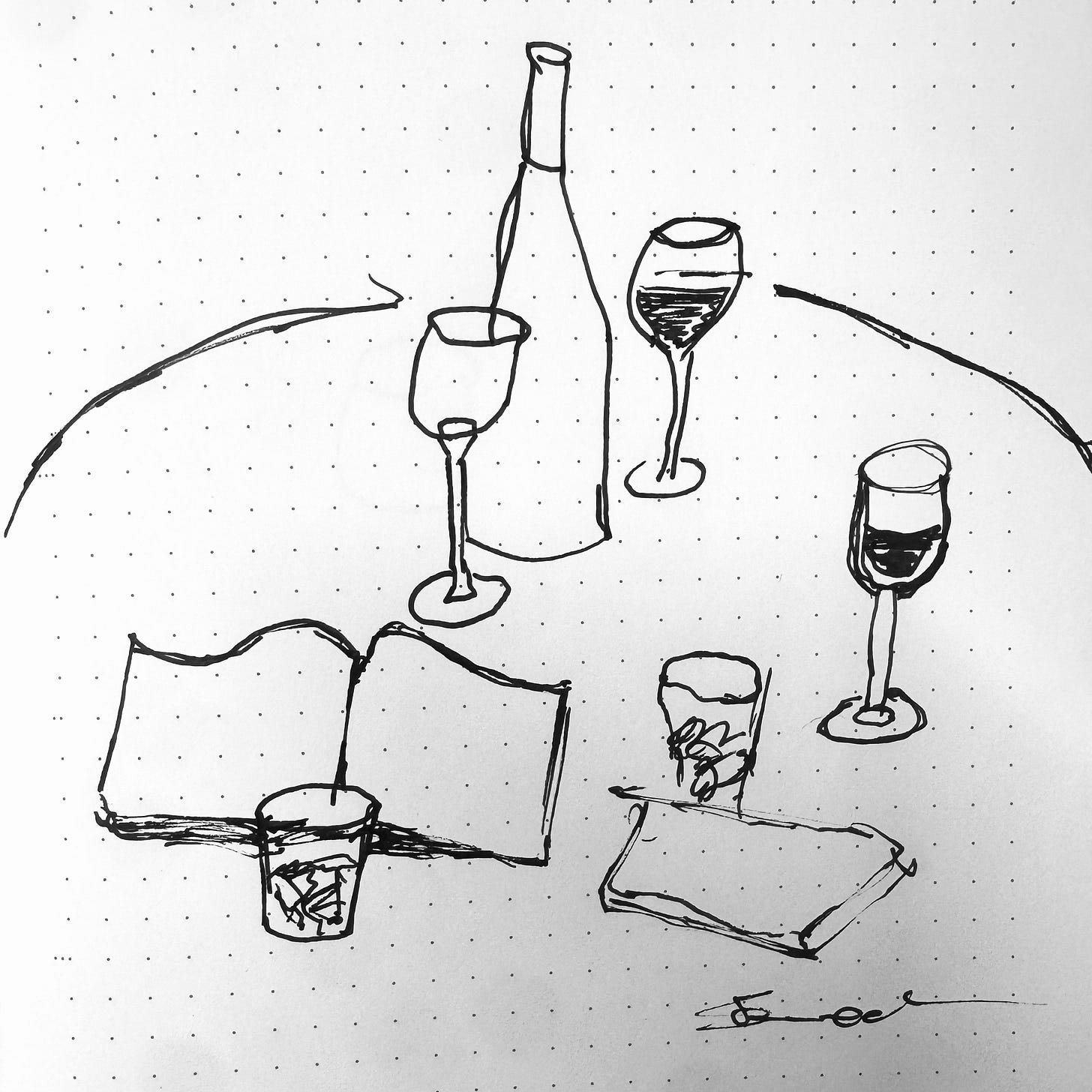
- Draw something. Most people never draw because they think they suck at it. I work part-time as a primary school substitute teacher. I’ve noticed that most kids naturally love drawing. Until around age 11-12. Once they enter adolescence, a loud inner critic emerges that turns drawing into a serious performance. What if you tried drawing without that critic? Stop thinking you need to make the next Mona Lisa. Draw something for fun again.
I like drawing random inanimate objects.
- Take a walk with no destination and no headphones. Since I started walking +10k steps per day last October, I’ve realized how great it is not just for the body, but for the mind. Walking has a therapeutic effect on the brain that is well researched. A 2025 study on college students found that walking just 25 minutes, three days a week, led to significant reductions in stress and negative emotions compared to those who didn’t. If you’re feeling overstimulated, a quiet walk is an easy way to regain mental composure.
- Prepare a really healthy meal for yourself. When I’m feeling overstimulated, one of my favourite things to do is go to the store, pick out the freshest ingredients, and make the most wholesome meal I can think of. Try it. It’s hard to feel bad after a great meal. Also, make sure to eat the meal in quietude - with no devices. Many of us feel the need to have a podcast or Netflix show running in the background as we eat. Go against this urge and eat without extra stimulation.
- Sit down at a café with only a pen and notebook. I did this every morning at 9 am for a two weeks while I was visiting Perth, Australia last year. There was this tiny, but charming café right around the corner from where I was staying that I’d go to with my journal. Sitting in a new environment and just observing is a great way to invigorate your creative mind and wake yourself up from auto-pilot living.
- Put on classical music and clean your place. The music is optional, but I find it gets me into the flow quickly. There’s something so therapeutic about cleaning. Every time I clean, I get like a +50% improvement in mood. I remember reading that the state of your living space is a reflection of your internal state. I’ve found that to be quite accurate. If you want to get rid of mental noise, clear up the clutter in your physical environment first.
- Talk to a camera without a script for 10 minutes. You’d be surprised how much mental clarity you can get from speaking to a camera for 10 minutes straight. The key is not to judge yourself. Don’t filter. Don’t worry about filler words or sounding intelligent. Let yourself ramble. Talk about whatever is on your mind. Don’t stop until you hit the 10 min mark. This is also an effective daily practice to improve at public speaking.
- Interstitial journaling. This is a writing technique that helps you use your time consciously. It’s especially useful for people with scattered minds. The technique involves logging what you’re doing and what you’re about to do throughout the day in real time. It forces a micro-pause before you autopilot into the next dopamine hit. Here’s an example of what the logs look like:
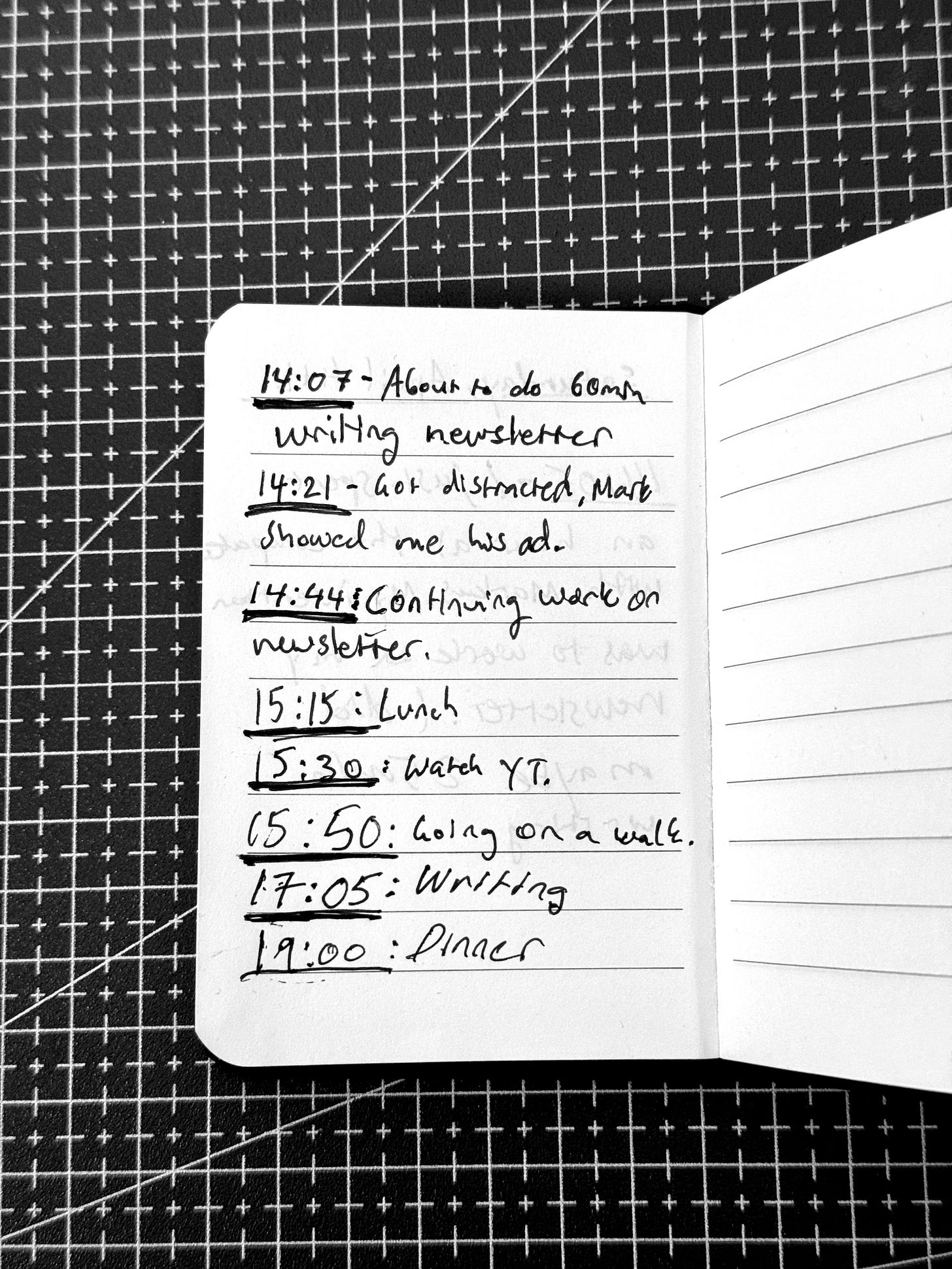
I’ll make an in-depth guide on how I do this soon, so if you’d like to learn more, make sure to subscribe to this newsletter:
- Have a workout without headphones. Yep, this is the second time i’m telling you to ditch the headphones. Go for a run, hit the gym, shoot some hoops. Train your body in your preferred way. But do it without music blasting in your ear. Let your brain rest and focus on moving your body intentionally. Even just 15-30 min is enough. No matter what state you’re in before the workout, you’ll always finish feeling mentally sharper.
- Send a handwritten letter to someone. Writing letters is a lost practice. I haven’t written one since I was a kid, but recently I decided to ask for the address of an old friend of mine and write them a letter. Could I just send them an email? Of course, but a handwritten letter just feels more meaningful. When you write a physical letter, you have to choose your words carefully, as you can’t just delete and retype like you do digitally. This makes the act of crafting your message more intentional.
- Open a window and stare outside for 10 minutes. Gazing out of the window is a surprisingly effective little habit I do on work breaks. It’s perfect because it gives your eyes a soft, distant focal point without needing to apply any cognitive effort. Jut let your imagination run wild.
- Detox from music. I haven’t done this one for longer than a few days personally, but I’ve heard some people talk about the benefits of quitting music for weeks or even months and it has got me keen to try it out at some point. I enjoy music a lot. But it can also be very stimulating and addictive. Music is one of those things people never think to question because it feels harmless. And it can be. But it can also be a problem if you never spend time with your own thoughts because of it. If that’s you, I recommend spending a day or two without music. I guarantee it’s more enjoyable than it sounds.
- Spend a full day without consuming content. Choose a day out of your week when you intentionally abstain from all forms of media. No videos, articles, video games, movies, podcasts, books etc. Instead, spend your time relaxing, and perhaps creating something, even if it’s just for yourself. Make a micro film with your phone, write a short story, do some street photography. Let your excitement guide you here. Spending a day in creative mode will help you reconnect with your “higher self,” leading to less desire to engage in cheap dopamine.
In Paris, shot on 35mm film by me.

- Dump every open loop in your head onto paper. Every task, worry, half-thought. Write it all down until you can’t think of anything else that you need to do in the foreseeable future. After that, circle the ones that are eating up most of your mental bandwidth and start closing them. Maybe you have some unpaid bills, unread messages, or dishes that have been piling in the kitchen sink. Whatever it is, just get to work closing it. Your mind will thank you later.
- Reorganize a drawer or shelf. I like to turn this into a game by setting a timer for 15 minutes and challenging myself to get it done before the finish line. Doing this gives your brain a small, but significant win that will immediately make you feel more productive and in control.
- Visit a museum. If you feel overstimulated, go to a museum near you. Spend time admiring art that makes you feel something. Even if you’re not an artist, being in the presence of great works of art is undeniably inspiring and may trigger dormant creative insights within you.
- Read from a physical book slowly and deliberately. If you’re in a dopamine hole, the last thing you’ll feel like doing is read. Do it anyway. Reading requires mental effort, especially if you’re genuinely trying to understand what the author is saying. Don’t worry about reading X number of pages. Just challenge your brain to stay with the words until something clicks for you. Reading is supposed to be a pleasurable activity. But if you don’t do it regularly it may not feel that way at first. Completely normal. Your brain has been trained to expect reward without effort. A physical book delivers reward at a slower rate. You have to earn pleasure, which makes it so much more satisfying.
- Pick something you’ve been avoiding and set a 30-minute timer to get it done. One of the most underrated questions to ask yourself is: What am I avoiding? We tend to get lost in cheap dopamine not because we’re somehow broken, but because we’re trying to avoid something we know we need to do. What if you faced that thing right now? A lot of the time, this is enough to change the trajectory of your entire day.
There are more things I could add to this list, but these are my favorite ways to break the loop of overstimulation.
Maybe you can spot the pattern. None of these practices involve the internet. Many of them may seem simple and boring. That’s by design.
In an overstimulated state, your brain thinks more is the solution. You know it’s not. The solution is less. Less input, less noise, less speed.
You don’t need to do all 17 of these. Pick one or two that feel doable. Try them this week without big expectation. I’m certain you will come out with more clarity.
And as a rule of thumb, the more resistance you feel toward the thing, the greater net benefit you will get from doing it.
Thanks for reading.
P.S.
This week, I ran the first session of my new "Free Your Focus” intensive, which went really well.
The program is designed to double your focus and output in a distracted world.
If that sounds interesting, reply 'focus' to this email and let’s have a chat. :)