How Our Leisure Time Got Monetized - by Ted Gioia


Back in the medieval era, there were 141 official holidays every year, according to scholar Pierre Émile Levasseur. That’s almost 40% of the year devoted to leisure. Even the French can’t match that.
And if you dig deeper into the past, lifestyles were even more festive. According to anthropologist Marshall Sahlins, prehistoric hunting-gathering tribes only worked around 15-20 hours per week.
This hardly changed until the Industrial Revolution.
As a specialist in the social history of music, I’ve tried to figure out what people did with all their free time. This is perhaps the most important question in the history of music and entertainment, but rarely gets asked. For the most part, the everyday music of earlier societies has disappeared without a trace.
But if you dig deeply into old source documents, you can start to put together the pieces. And—as I show in my book Music: A Subversive History—the everyday music of medieval life was often outrageous.
Pieter Bruegel the Elder, The Peasant Dance (circa 1567)
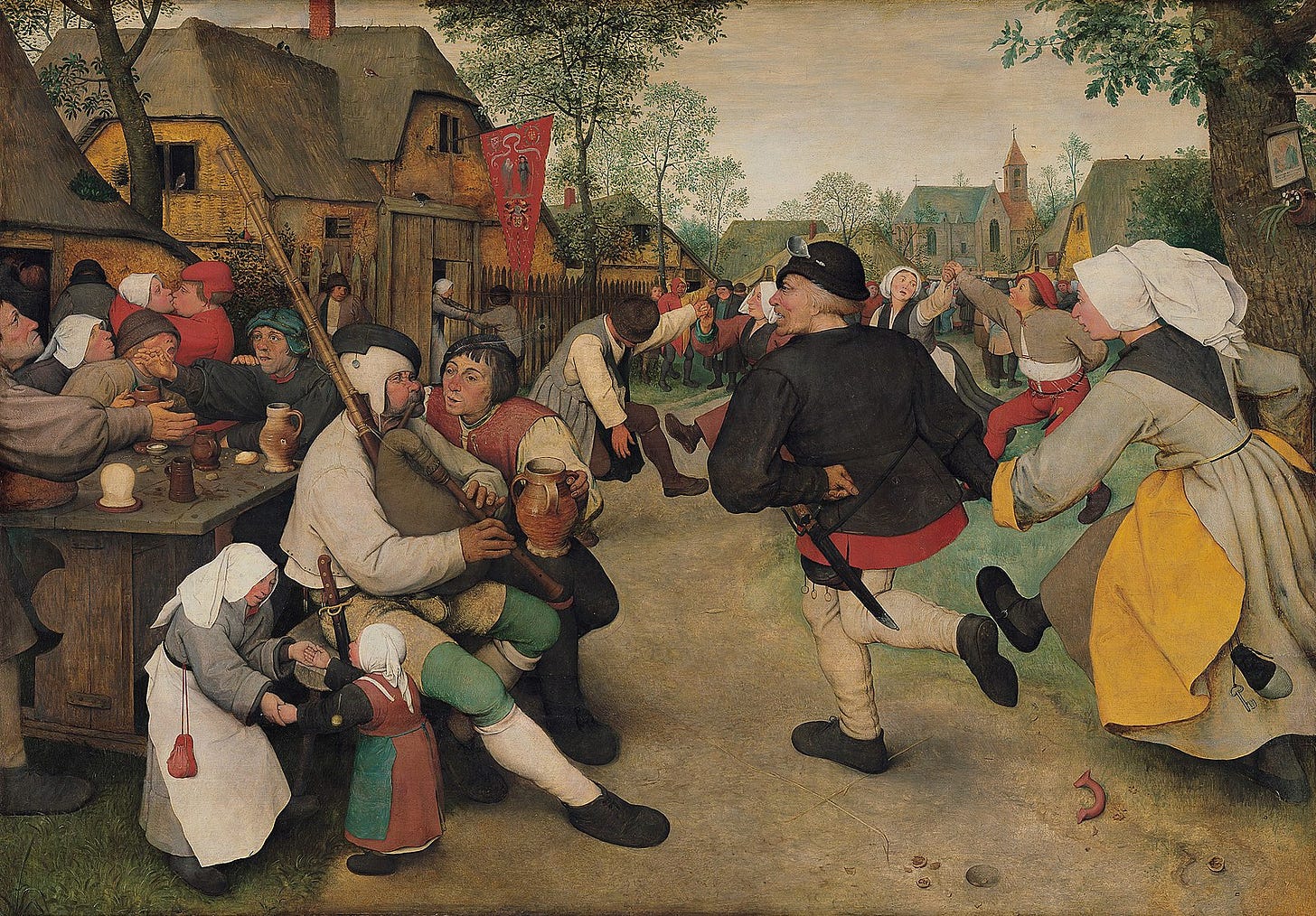
The partying got out of control, even during religious celebrations. I’ve tracked down numerous church documents from the Middle Ages that mention music—and the clergy complain bitterly about dirty songs and lewd dancing.
The authorities kept trying to stop it, but never really succeeded. Dirty dancing has always been with us, and always will. Today it’s Madonna, but back then it happened on the Feast of the Madonna.
For most of the last two thousand years, party songs were censored—so almost none of them have survived. But I can make one claim with absolute assurance: While our ancestors were enjoying these feast days, they didn’t make money for huge corporations.
Life is different now. People use up their leisure time scrolling through web ‘content’ saturated with advertisements—teens especially, who devote 4-5 hours per day on these platforms. Or they binge on Netflix. Or pay to play video games.
Most of the world’s free time has now been monetized by tech companies. In fact, the monetization of leisure time is how Silicon Valley execs make their billions. Our fun is their gravy train.
As recently as a hundred years ago, leisure time existed in a media-free zone. Nobody expected you to make money for wealthy elites on your day off.
I sometimes talked with my father about this. He was old enough to remember a world before mass media. Not only did he experience life before television, but he actually pre-dated the mass adoption of radio—which didn’t show up in most American homes until the mid-1920s.
He was almost ten years old before a radio arrived in his home.
I asked him what his family did in the evenings without TV or radio or an Internet connection. Can you guess what he said?
He told me that people would talk to their friends and neighbors. Many would go outside and sit on the porch in the evening so they could participate in the give-and-take of the larger community.
Can you imagine that—going outdoors and talking to your neighbors? Tell that to your kids. They won’t believe you.
My father told me that people in the neighborhood who were good storytellers and conversationalists were always in demand. They had the gift of gab, and were welcome in every home. It was like Substack, but in the flesh—and no subscription fee.
I was reminded of this years later, when I learned about anthropologist Andrea Migliano’s survey of 300 members of a hunter-gatherer tribe in the Philippines. She asked each respondent to pick five people they would want as companions if they were setting up a new community.
She expected that whey would choose the best hunters. Or maybe the strongest or the best at building. Or perhaps the best healer or the smartest leader.
Instead they preferred the best storytellers.
You probably would too, if you were cut off from mass media.
Of course, my father did other things as a youngster—especially play baseball. He had dreams of doing it professionally, but he unfortunately went to a high school packed with future major leaguers. (He said that the two students who beat him out in tryouts for catcher on the school team—Mickey Owen and Roy Partee—both ended up in the major leagues.)
“I couldn’t believe I was no better than third string,” he told me. “I thought I was a pretty good ball player. But it made sense when I saw those two other boys go pro.”
He also loved live music and dancing. He won trophies for his dance skills—which his Sicilian immigrant mother (who never learned to speak English) threw out with the trash. She was embarrassed that her son spent so much time dancing to jazz bands.
My father didn’t have much money—he was a teenager during the Great Depression. But you could have a good time in Los Angeles back then without cash. He could go to the beach, or take a walk with friends, or play ball on an empty field, or deal cards, or listen to neighbors who made music.
That was all free.
Most of your leisure time was spent joyfully, without monetization by huge corporations. There was a strict division between work and play—and only your work time was expected to generate corporate income.
Most of this world had disappeared before I was born. But I still got a taste of non-monetized leisure as a child. I competed in sports, went for walks and outings, and spent a lot of time playing chess and making music.
I also read a lot of books, most of them borrowed from the library. That was totally free, too—unlike Netflix or HBO today. And when I purchased a book, I often went to a used book store on Hawthorne Boulevard where secondhand paperbacks cost around 25 or 30 cents each.
The owner often tried to tempt me to spend more. He said he would sell me one hundred paperbacks for just ten dollars. He made that offer repeatedly. But I never had ten dollars, so he was wasting his breath.
The Hawthorne Public Library on Grevillea Avenue was like my second home, and didn’t cost a penny.

There were so many pastimes that were free, or almost free. I played ping pong against my father (he was wickedly good), and worked jigsaw puzzles with my mother. I challenged both of them in pinochle. We played a lot of board games—including Scrabble, Risk, Clue, Monopoly, Stratego, and (if we were especially ambitious) Diplomacy.
My schoolmates and my brother’s friends often joined in, and cross-generational games and competitions were a regular occurrence. We did this more for the banter and sociability, and didn’t worry much about who won or lost.
We also told a lot of jokes—and jokes were much, much longer back then. (In a real oral culture, a joke that just lasts a few seconds is practically worthless—the exact opposite of today’s dopamine jolt comedy.) And we knew all sorts of puzzles, and guessing games, and stunts—and were always trying to learn more.
I failed at juggling, but got very good at doing card ticks. Almost every one of my buddies had some special skill of this sort, requiring coordination, practice, and a willingness to perform.
I want to emphasize that every one of the activities mentioned above was social and communal. It brought you closer together with family, friends, and neighbors.
Corporations didn’t make much money off all this. Sure, somebody had to buy a deck of playing cards, or some chess pieces, and the other required paraphernalia. But you could get years of enjoyment from tiny expenditures.
There were no monthly subscription fees for our ping pong table. There were no in-app purchases on the Scrabble board. The piano in our home, inherited from my uncle, didn’t need upgrades and a credit card number on file.
And some games were absolutely free—word games such as “20 Questions” or pantomime games like “Charades.” We all knew dozens of ways of entertainment that didn’t cost a penny.
Ah, the whole texture and ambiance of the world was different before leisure got monetized.
I’m not arguing for a nostalgic return to the past. Just stop making us work for the man during all our spare time. If we could open up our leisure to more non-corporatized activity, even for just a few hours per week, it would be healing.
Some people tell me that there is no conclusive proof that this shift in our leisure time is bad for people. They want more evidence.
I must say that this response leaves me dumbfounded. It feels like they are shilling for the man.
I’ll ask you straight up—which is healthier for youngsters: (1) My dad’s leisure time spent in baseball, dancing, friendships, storytelling, and other social interactions; or (2) non-stop scroll-and-swipe?
If you need more information to answer that question, you probably shouldn’t be a parent.
This is not a philosophical debate, and it certainly has nothing to do with nostalgia. Even just from a physical fitness point of view, the choice is clear. And don’t even get me started on mental health issues.
How many advertisements do we consume in this mind-numbing way? Marketeer Ron Marshall decided to count the number of ad exposures he had in a single day—and he got to 487 even before he finished his breakfast.
I’m not sure anybody has made a totally accurate measure of our daily monetization. But there has to be as much ad garbage in our heads right now as microplastics in our body.
It’s not unreasonable to put some limits on how corporations maximize income from captive users by monetizing their leisure hours. And, sure, I understand that billionaires are gonna billion. But don’t insult my intelligence by pretending that their manipulation of vulnerable youngsters is socially beneficial.
Their schemes go unchecked and, as a result, the culture is polluted. Even worse, the mindspace of the users of that culture is polluted as well. A society that doesn’t protect youngsters from this is destroying its future.
Most people have already figured this out. Only the policymakers—influenced by tech lobbyist cash—pretend not to notice.
But this elephant in the room will soon be impossible to ignore. We are only beginning to grasp the social cost of intensely monetized leisure—but already the price is far too high.
In the future, I plan to write more about leisure. I especially want to focus on its origins in ritual, festivities, sociability, and relaxation. In Western culture, the Day of Rest was actually sanctified—and the people who tried to monetize it were thrown out of the temple.
That might still be a sound policy today.