文学爱好者应该欢迎人工智能成为文字创作的伙伴 | Aeon Essays

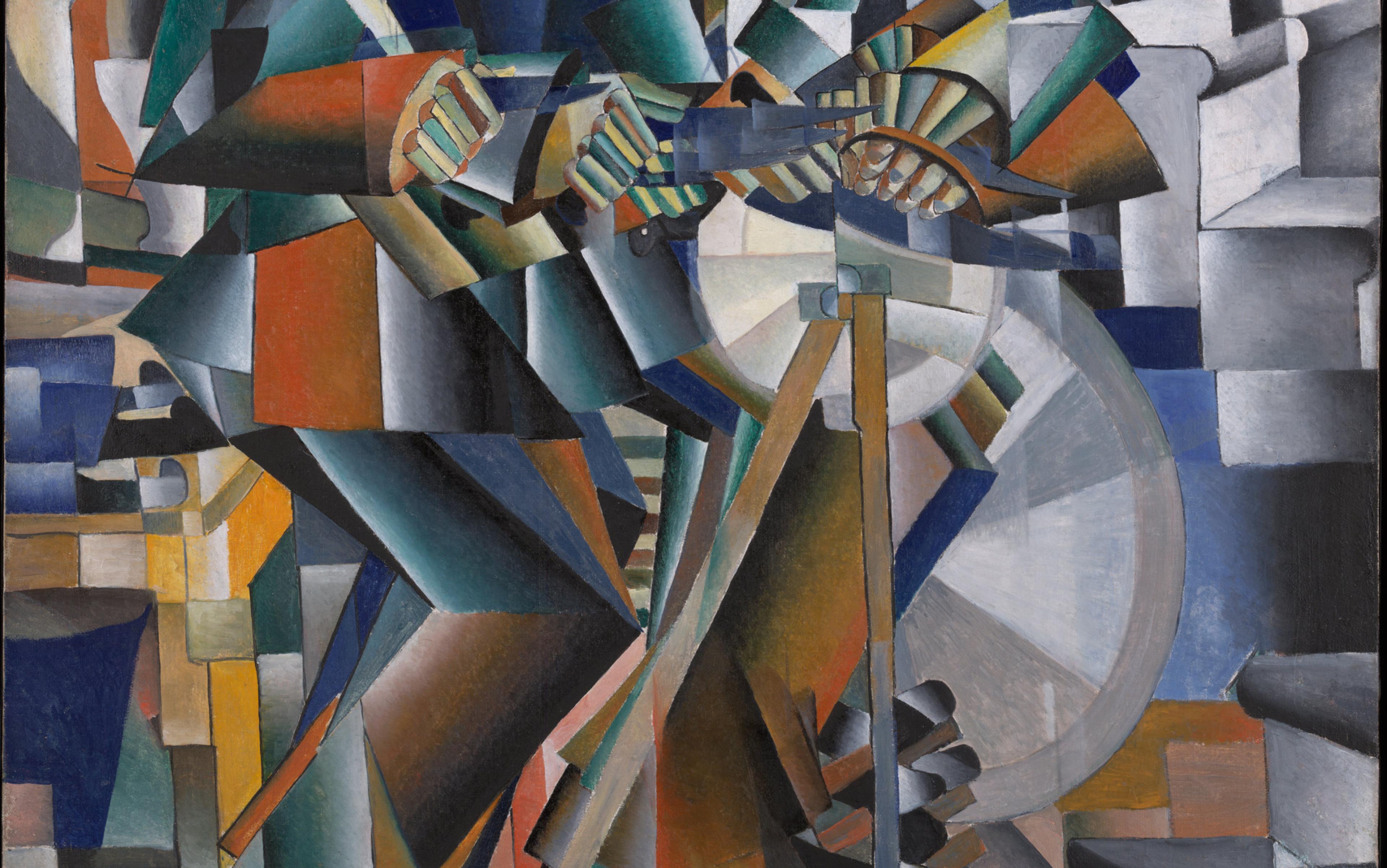
Studio Schwitters (2010), a sound installation by Pavel Büchler, plays the Dadaist sound poem Ursonate (1922-32) by Kurt Schwitters. Photo by Christophe Gateau/dpa/Getty Images
Strong resistance to AI among writers is understandable. But it obscures what we share with the machines: language itself
Martin Puchner
holds the Byron and Anita Wien Chair in drama and in English and comparative literature at Harvard University. As general editor of the Norton Anthology of World Literature, he has brought 4,000 years of literature to students across the globe. His books include The Written World: The Power of Stories to Shape People, History, and Civilization (2017), The Language of Thieves: My Family’s Obsession with a Secret Code the Nazis Tried to Eliminate (2020) and Culture: The Story of Us, from Cave Art to K-Pop (2023). He writes the Substack In Practice.
Since artificial intelligence went mainstream a few years ago, it has done double duty as a political personality test: tell me what you think about AI, and I’ll tell you who you are. Those worried about climate change focus on energy consumption. Those who denounce late capitalism see it as the ultimate example of corporate monopoly. Those concerned about racism have warned about AI biases. Those studying the effects of colonialism see it as yet another form of exploitation. And those tending toward doom have seen ChatGPT, Claude, Gemini and Grok as the four riders of the apocalypse.
People in the arts and culture have felt particularly threatened by AI because the technology seems to be coming for the things they cherish the most: the creative use of images, words, and ideas. The latter two, words and ideas, have been in the centre of the storm because generative AI is based on language and because ideas are closely associated with the words in which they are expressed. In response, writers have largely opted for resistance, defending the genuine creativity of humans against the machines. My social media feeds have been flooded with AI-slop gleefully produced and circulated by colleagues hoping to prove that AI can’t be creative. Let’s call this the Creative Resistance.
Based on my experience teaching and lecturing across the world, the Creative Resistance is strongest in North America, much less dominant in India, and still less in China and Korea, with Europe somewhere in between. When I taught a class on AI and creativity in Seoul last summer, with students from across Asia as well as Latin America, they had a single concern: please teach us how to use these tools effectively. The only person calling for creative resistance was an American student who had strayed into the class. In India, too, I’ve had many interactions with people in the arts that showed a less defensive, more exploratory attitude.
These anecdotal impressions are backed up by research measuring attitudes toward AI in different locations more generally. It’s tempting to speculate about reasons for this unequal distribution. The filmmaker Shekhar Kapur told me in a conversation that it was a matter of defending entrenched privileges: people in the Global South have less to lose and are therefore more open to new technologies. There might also be deeper philosophical and cultural attitudes, with Buddhist-inflected cultures less invested in the distinction between humans and non-humans.
No matter where it exists, the Creative Resistance is understandable as a reaction to a disruptive technology, but ultimately it gets in the way of understanding AI. Over the past three years, I’ve experimented with AI and have come away a cautious optimist. AI may well be terrible news for software engineers, but I think it’s an intriguing development for people who care about language and ideas – precisely the people who currently reject it the most.
The Creative Resistance has a point in that AI raises questions about what machines can and cannot do – but it also raises similar questions about humans. Many of the faults the Creative Resistance sees in AI – that it is predictable, that it merely recombines what is already there – are also true of many humans. In fact, much work in the arts of the past decades has questioned claims about human creativity. These include the cult of the lone genius; the role of institutions in shaping art; the reliance on tools and media; and collective modes of creative production. It’s been strange to observe how quickly writers and artists, when faced with the threat of AI, have forgotten all that and are now seeking refuge in very traditional views of human creativity. It’s almost as if we were back in the world C P Snow described in the 1950s, divided between avant-garde science and tradition-bound arts and humanities.
The main problem with the Creative Resistance is that it blinds us to what is most interesting about AI, namely, that it is based on language – something we share with AI. To be sure, machines and humans learn language differently, process it differently, and interact with it differently. But these differences don’t mean that only we humans really use language while machines just mimic it. AI agents are astonishingly effective users of language, though with different strengths and weaknesses from us. Acknowledging this doesn’t commit us to saying that AI is conscious, a famously difficult concept to define, or in other ways human-like. Indeed, one of the strengths of AI is that it uses language differently from us. But the point here is that language is the terrain on which humans and machines meet. Let’s call this the Shared Language Model, which also explains why humans can interact with AI in the first place.
Living with the Shared Language Model is something that we need to learn. Until recently, it was reasonable to assume that all speaking agents were humans (apart from trained parrots), hence our ingrained habit of attributing personhood to chatbots, with all the much-publicised consequences. But now we need to get used to having another language-user among us.
Many readers feel cheated when they learn that a text was written by AI. But will this attitude persist?
Many disciplines will be needed to help us understand the implications of AI, including engineering and mathematics. But they also include two theories associated with the humanities: reader-response criticism and post-structuralism. Both happen to be the theories I grew up with intellectually, and I have found both surprisingly helpful in grappling with the AI challenge.
Reader-response criticism developed in the 1970s and ’80s in Germany and the US by challenging the standard view that literature gets produced by an author (or several authors) using different media (manuscript scrolls; printed books) and then transmitted through intermediaries (libraries; bookshops) to readers, who then, well, read it. Not so fast, said theorists such as Wolfgang Iser in Germany and Stanley Fish in the US. The assumption that literature is what’s trapped between the covers of a book leaves out readers, who in truth co-produce literature through the act of reading. Literature is not words on paper; it is words on paper that are being read by readers. In its most extreme form this meant that it didn’t matter how (and by whom) a text was written; all that mattered was how it was read. The act of reading was everything, and the words written by an author merely an excuse for an act of reading to take place.
The centre of reader-response theory was the University of Konstanz, a newly founded university in the far southwestern corner of Germany, right on the border of Switzerland, where I went to study in the late 1980s. In my first semester, I wandered into a seminar by Iser, the author of The Act of Reading (1976), one of the key early works of this movement. When I came home for Christmas that year, I regaled my family and friends with the startling claim that literature was not what they proudly displayed on their bookshelves, but something that came into being only once they started reading.
AI is a perfect experiment in reader-response theory. Does it really not matter who (or what) produces a text? Right now, the verdict seems to be that it matters a great deal. The Creative Resistance in particular has everything invested in the difference, and many readers feel cheated when they learn that a text was written by AI. But will this attitude persist? The core insight of reader-response theory helps us phrase this question in a better way: what matters is not the words themselves but how we read them. For AI, this means that the real question isn’t how good AI-produced texts will be but whether readers will continue to read them differently (or not at all).
Language is not some magical capacity that makes us human, but a strange technology that has taken hold of us
The other literary theory that can help us understand AI is post-structuralism. This was the theory I was introduced to in graduate school, having graduated from reader-response criticism. It is also what brought me to the US, where I went to study with Jacques Derrida, who was regularly teaching at the University of California, Irvine. I remember when I first gathered all my courage to go to Derrida’s office hours. I expected a long line of fans, but instead found him sitting completely alone at the end of a long, empty corridor. I returned a few times, eager for these slightly awkward exchanges in imperfect English (we both got better as the semester progressed). Mostly, he wanted to talk about his fear that people were merely imitating his style of thinking without the substance. This worry stayed with me and made me ultimately turn away from post-structuralism.
But now, when faced with AI, I’ve come to see that post-structuralism got something important right, namely that there is nothing natural about language. Language is not some magical capacity that makes us human, but a strange technology that has taken hold of us and changed how we think.
The way Derrida made this argument was seemingly counterintuitive: writing is more fundamental than speech. This claim went in the face of historical evidence that humans had first evolved the ability to speak around 100,000 years ago and then, much later, learned how to capture spoken words through written signs. What bothered Derrida about this story was that it made language seem natural, and writing artificial, when in truth all language was artificial: a thinking tool. The best way of making that point was to show that speech contained traces (an important word for Derrida) of writing, in the sense that it was an artificially created system that operated according to its own rules. This artificiality was easier to see in writing, hence his claim that writing, this overtly artificial technology, revealed something about speech that might otherwise be difficult to see. In fact, post-structuralism didn’t come up with this theory in a vacuum, and some post-structuralists, such as Jacques Lacan, actually read the theorists behind the AI revolution, such as Claude Shannon and Norbert Wiener.
Besides literary theory, there is another source at the disposal of writers that can help us take the measure of AI: cultural history. From the Pygmalion myth to Karel Čapek’s play R.U.R. (1920), in which this Czech writer coined the word ‘robot’, literature has long been thinking about AI. The best literature here is not confined to doomsday warnings à la The Terminator, though worries about the loss of control can be found in such myths as the Sorcerer’s Apprentice, who unleashes a magic mechanism he cannot control. Other stories about intelligent creatures can be found in tales about magic lamps and flying carpets, ghosts, jinn and fairies, oracles and gods. We writers and scholars possess vast cultural resources for thinking about other forms of intelligence, if only we figure out how to use them.
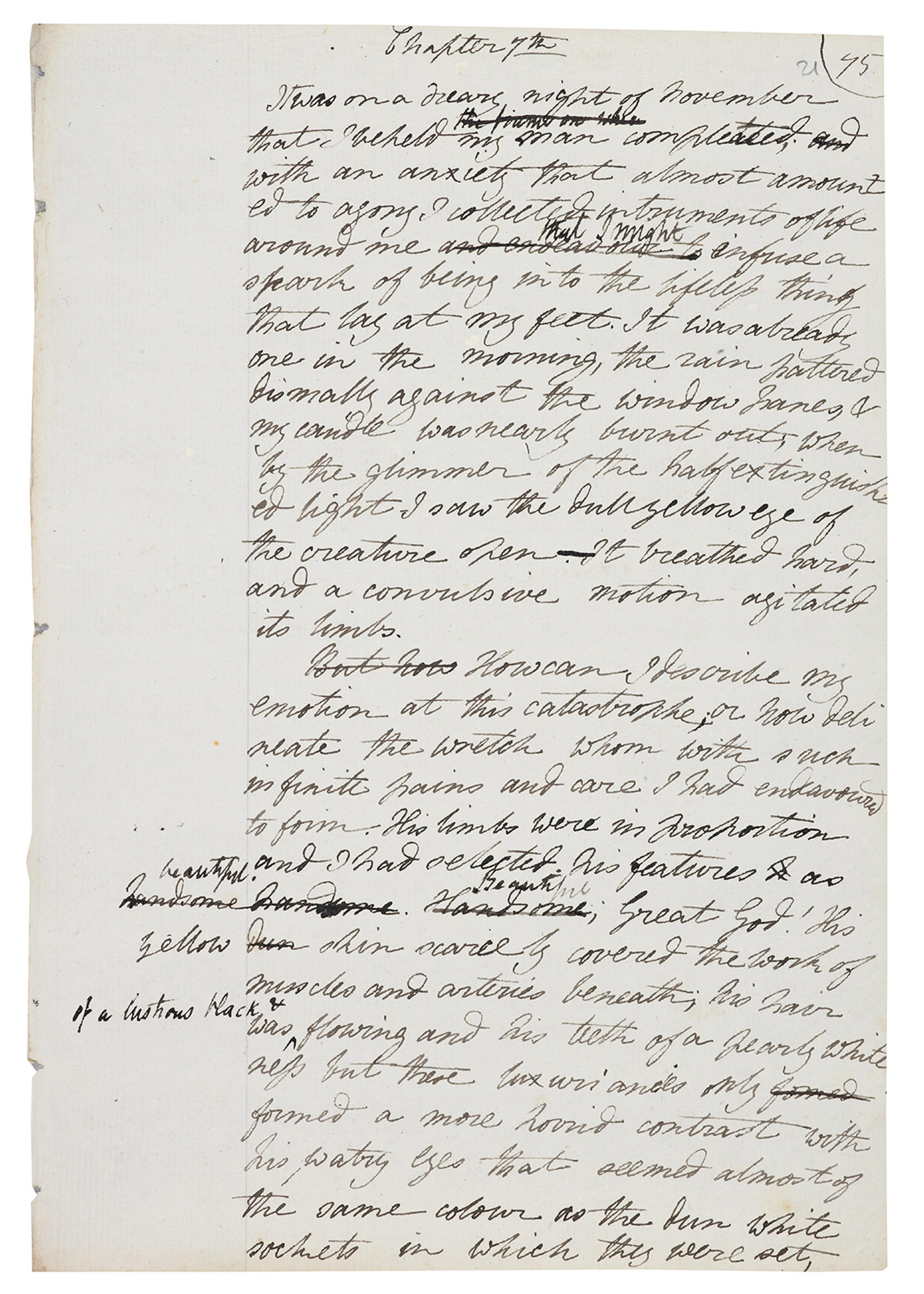
Image of a handwritten manuscript page from a book showing edited text and corrections in ink.
Take a novel such as Frankenstein (1818). In light of AI, we can see that Mary Shelley thought extremely hard about the role of language and what we would call training data in the creation of an artificial creature. In the novel, Dr Frankenstein abandons his creature before completing it: he has given it outward form but no knowledge or education. Cast into the world, the creature must now acquire those on its own: Shelley has it acquire language by spying on a family of humans over a period of months.
The Terminator’s cultural footprint is part of the training data and is therefore shaping the behaviour of chatbots
But that is not enough. The creature must acquire book-based knowledge as well. Shelley specifies precisely four books that the creature reads, and that in fact shape its subsequent reactions to the world, its intelligence. This training data is Plutarch’s Parallel Lives; John Milton’s Paradise Lost (1667); J W Goethe’s Sorrows of Young Werther (1774); and C F Volney’s The Ruins (1791), a work about the history of civilisations. These four texts, Shelley’s super-canon, instil in the Creature its notion of greatness based on classical ideals (Plutarch); a dramatic sense of creation and its moral challenges (Milton); a language of interiority and feeling (Goethe); plus a tragic sense of world history (Volney).
Approaching AI from deep cultural history can also help explain some of AI’s most disturbing behaviour. Because our AI has been trained on the collective, digitised inheritance of human thought, this history of imagining AI is actually part of that training data. At least some of the creepy interactions between humans and AI chatbots that sound like something straight out of The Terminator actually are straight out of The Terminator – not because the cyborg assassin franchise accurately predicted the future, but because its cultural footprint is part of the training data and is therefore shaping the behaviour of chatbots. Writers, equipped with a good understanding of the canons of world literature, would be excellent analysts of such cultural feedback loops.
Training data – the ingestion of vast quantities of human-created text, from the great works of world literature to all of Reddit and X – raises the question of copyright. As is widely known, AI companies have trained their models not only on public-domain books (such as the works of Plutarch, Milton, and Goethe) but also on enormous repositories of protected ones (including several of mine). Writers and artists have been indignant that private companies first steal our work and then offer to sell it back to us at vastly discounted prices. The lawsuits resulting from this widespread act of piracy are currently making their way through the courts and will probably be settled in favour of authors, as they should be. But AI also raises trickier questions about ownership and art. True, creative producers have long relied on copyright protections to make a living by their craft. At the same time, they have depended on the right to use works created by others through the doctrine of ‘fair use’, which allowed them to appropriate and transform protected works in creative ways. AI companies not only violated anti-piracy laws. They also claim the same ‘fair use’ doctrine designed to protect the creative freedom of artists. This, more than the more straightforward acts of piracy, threatens the careful balancing act between protection and artistic freedom that has sustained art for more than a century.
As a writer and cultural historian, I have experimented with AI for the past three years and want to encourage more writers and artists to do the same. In the past, there have always been a few technically versatile artists who programmed computers for creative uses (I was not one of them). But now only minimal technical knowledge is required to access and work with large corpora and canons, and create custom tools while using nothing but our favourite technology: words, words, words.
The most thrilling experience for me has been vibe coding (building software by giving AI conversational prompts). As soon as it hit me that Shelley’s novel contained eerily prescient instructions about language use and training data, I got to work creating a chatbot. From what I had learned, the Creature was basically screaming to be implemented in a RAG-based chatbot. RAG-based chatbots are based on large language models. Looked at in terms of the novel Frankenstein, the LLM is like the first phase in which the Creature learns to speak, learning to use language as a tool. Then comes the next phase, the RAG phase, when it reads four precise books that will shape its subsequent behaviour. A RAG process means adding a knowledge base of four texts. These texts, once they are turned into a searchable format (technically, a vector space), now form a primary filter that shapes how the chatbot uses language. The process required a few other steps and a lot of trial and error. But eventually it worked: I had created Frankenstein’s Creature, thanks to Shelley’s precise imagination. Since then, I’ve created a few dozen such chatbots, or, as one of my students put it, a Jurassic Park for literature.
Thanks to vibe coding, I can now think much more concretely about how these materials might be applied
Encouraged by these early experiments, I have moved on from RAG-based chatbots to vibe-coding apps that put these chatbots in action. One project is an app that stages debates among these philosophers, allowing what many philosophers and humanists have long dreamed about: assembling the best minds in the world and having them talk to each other. Another gives more practical advice about career and life choices, a kind of philosophically grounded executive coach.
Both experiences have changed my approach to the creative materials I’ve been teaching for decades: thanks to vibe coding, I can now think much more concretely about how students – or anyone, really – might interact with these materials and to what end. In other words, how these materials might be applied. Vibe coding has taught me to think more like an engineer. ‘To a person with a hammer, everything looks like a nail,’ the old quip has it. I’ve always thought that what looks like a critique – ‘not everything is a nail’ – is actually a profound insight: hammers have turned us into a hammering species. In order to wield a hammer effectively, we need to see the world in its light, which is to say, as a bunch of potential nails.
Something similar is happening with vibe coding: I now see the world in terms of applications. In the back of my mind, a new way of thinking is always running: can I turn this insight, that philosophy, into something that might have concrete, practical use? I’m not saying that everyone needs to adopt this kind of attitude, just that AI has enabled writers willing to experiment with it to do so.
Almost all teachers in the liberal arts worry about deteriorating reading, writing and thinking skills among students who routinely use AI. And it is true that there is good evidence that too much AI use for certain tasks can prevent students from learning crucial cognitive skills. This means that K-12 and college education must include teaching strategies from the pre-AI era, the ones we all, including AI enthusiasts such as myself, have benefited from over decades of analogue schooling. And since assignments and assessments perform an important incentive function, it is right to structure those so that students cannot always use AI, whether that means in-class writing assignments, oral exams or other techniques. The point is that students must be kept from the temptation of always using AI as short-cuts, so that they can develop crucial cognitive skills, including metacognitive skills (or learning how to learn) such as note-taking, outlining, research, revision.
At the same time, students, such as the ones in my classes in Korea, are absolutely right to demand that college teach them how to use evolving AI tools. And since those tools are evolving so rapidly, it’ll be necessary to teach students what might be called ‘meta-AI’ skills, that is, approaches to thinking about how to use AI. Observing my own use over the past two and a half years has given me a glimpse into what this might look like. It would involve learning how to effectively interact with AI, learning how to think like an engineer. It would also involve thinking about applications, how insights can be tested and applied through AI (or other) tools.
One area in which I myself have tried to implement such an approach is an online writing course I have developed over the past three years. Our approach was to teach students a step-by-step process of writing that includes how to ask a viable research question, how to do research, how to construct an argument, how to marshal evidence, how to revise a thesis based on counter-arguments and counter-evidence, how to structure an essay, how to get feedback, and how to revise. The goal is to present writing as a technique for thinking, including the ability to avoid common logical fallacies. We felt that students absolutely needed to struggle through this cumbersome process in order to learn sophisticated cognitive skills. Writing, here, was presented as a process of thinking and therefore should not be outsourced to AI.
We teach students how to create AI agents that act as sparring partners, forcing them to sharpen their thinking
Even if students will rely on AI for many forms of writing after college, they need to develop those cognitive skills that are available only after struggling with a longer essay yourself, through many revisions. In addition, this process will put students in a position to judge the quality of AI-produced writing. Finally, AI encouraged us to stress those stylistic skills, such as going out on a limb, and coming up with surprising phrases and unusual metaphors, that AI is famously bad at. Even if AI-generated writing is good enough for many writing tasks, there is a premium on knowing how to be better than AI.
At the same time, we felt that, if used right, AI could enhance the process of writing and thinking. To this end, we teach students how to create AI agents that act as sparring partners, forcing them to sharpen their thinking by reacting to counter-argument and counter-evidence. AI can also be used as a research assistant and to play with different structures. Finally, since the course needs to be scalable, we constructed agents trained to give precise feedback on first drafts, and acting as aids for planning the revision process.
Since creating this course, this is how I have used AI myself. I have created various custom assistants that know my projects and whom I have instructed to stress-test my ideas and arguments. Of course, this does not replace reading and speaking to humans, but it has evolved into a critical practice that I have built into my thinking and writing process.
AI is a powerful technology that will have lots of intended and unintended consequences. There are good reasons to be worried about its impact on the labour market and on education, among other areas. In this context, it’s especially important that we wordsmiths get AI right. To this end, we have at our disposal theoretical and historical tools to help us figure out what AI is and how we should interact with it. Let’s use them.