"创作许可 - Jolie Gan 著" --- License to Create - by Jolie Gan
This essay is Part of 2 a 2-part series. In Part 1, I made the case for researchers as creatives. This piece shows how.

The Social Network never made room for a Met Gala cameo, but when Jeff Bezos walked the carpet, alas, worlds collided.
That moment said more than a thousand think pieces about the cultural trajectory of tech as we know it. Software stopped being “the nerd in the basement” and became billboard-ready, culturally aspirational, stuff of dinner table conversation.
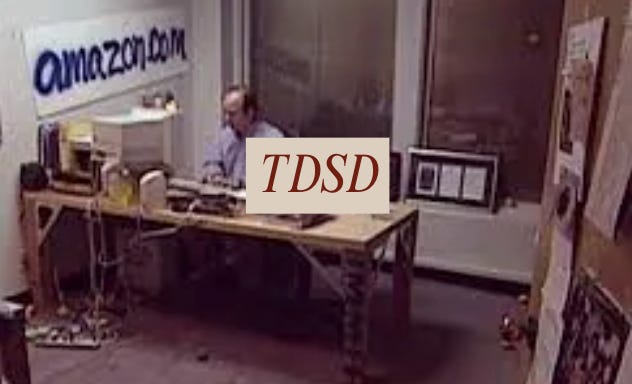
Early Amazon.
That convergence of tech (a vertical) and mainstream culture (horizontal) didn’t just happen because the code got better. It happened because the tooling to make it legible got better. Mac OS, GitHub, Figma, Twitter — each of them lowered the lift of distribution, making technical work culturally relevant — enough to catch the eye of even Anna Wintour.
In Part 1, I argued that researchers are on the cusp of the same transformation – what I call the rise of the researcher-creator. I highly recommend reading that piece first.
In case you didn’t, the TL;DR is that the incentives for research to become more publicly engaging are aligning. It’s no longer enough to hide behind a wall of text, hoping the right reviewer at Nature notices. Capital is moving private, where tech already dominates with speed, visual engagement, and cults of personality – if research wants to compete, it’ll have to lean into some of that language, too.
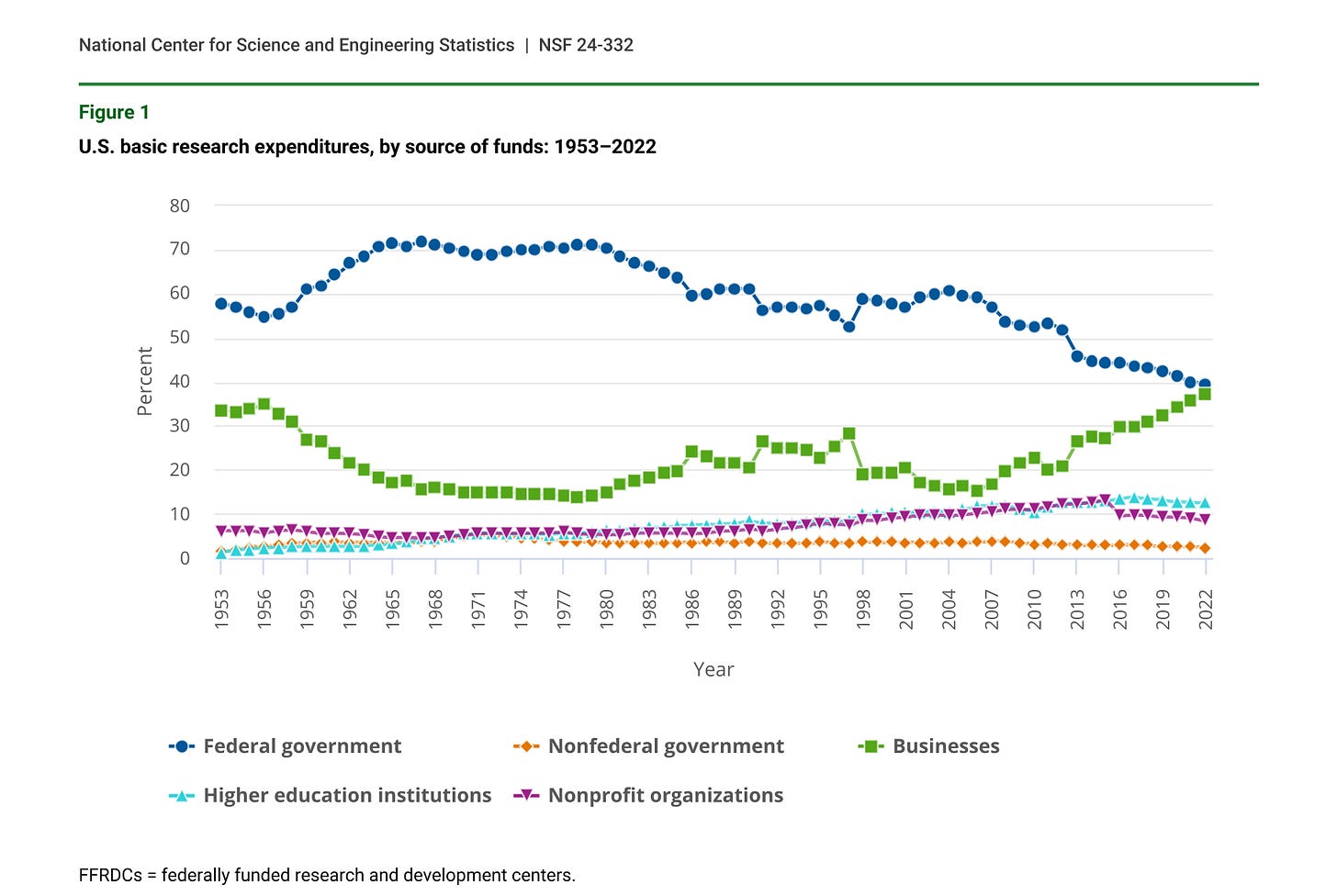
As of 2022, government and private capital held near-parity shares of research funding. Source
Part 2 is about what this looks like in practice. What are the formats researchers can already borrow? What new kinds of tooling need to be built to lower the lift? What will this look like in 1, 5, or 10 years? And who is best positioned to build them?
Early critique I’ve gotten on this thesis generally falls into three points:
- Won’t this dilute technical rigour?
- Doesn’t asking scientists to market themselves cheapen their work? Wouldn’t it be better to just hire a comms team and keep research “pure?”
- Aren’t scientists just…not cut out to be public facing? Their personalities just don’t click.
I understand the instinct. But this is also really simple to rebut.
- If you think posting on socials, giving your work a personality, or putting more effort into design can somehow confound its quality, that says more about the research than the presentation. We eat with our eyes first — and outside academia, a polished UI signals quality, not slop. It’s tiring to see research treat “marketing” or “branding” as dirty words.
- If the work doesn’t get seen, it doesn’t get funded. If it doesn’t get funded, it doesn’t exist. What happens when you lose media circulation from your university? When the grants dry up, who are you going to turn to to draw funding from elsewhere? How do you get generalist investors, funders, nonprofits to take your call or reply to your email when they don’t get it? You can pick your battles.
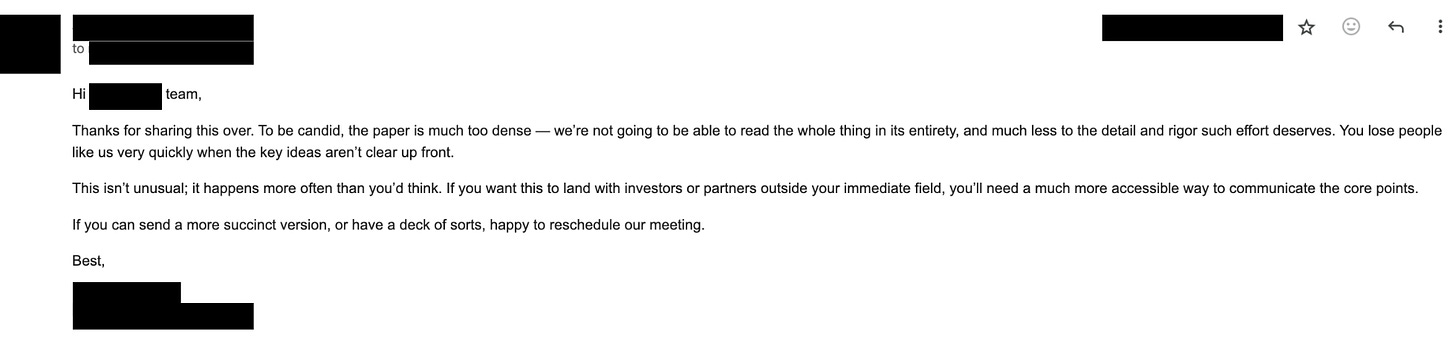
An email from an investor for a team I consulted for. Our paper was too dense, and though we got the meeting, it was a rare save. This happens often.
And while not every researcher needs to become Spielberg, we live in an attention economy. Being technically sound will get you part of the way, but distribution determines whether you survive the long haul. That doesn’t mean every lab should chase hype for hype’s sake. But it does mean researchers need new tools, habits, and formats to meet audiences where they are — not just other specialists, but generalists, funders, and the broader cultural fabric.1
The Opportunity Gap
So why hasn’t this shift already happened?
- It is. There’s already a small pioneer group of frontier scientists partnering with studios and creators (Jason Carman, Cleo Abram) and a rising number of production teams being formed to meet that demand. Generally, these research teams are still quite laissez-faire and handing it off to the creatives.
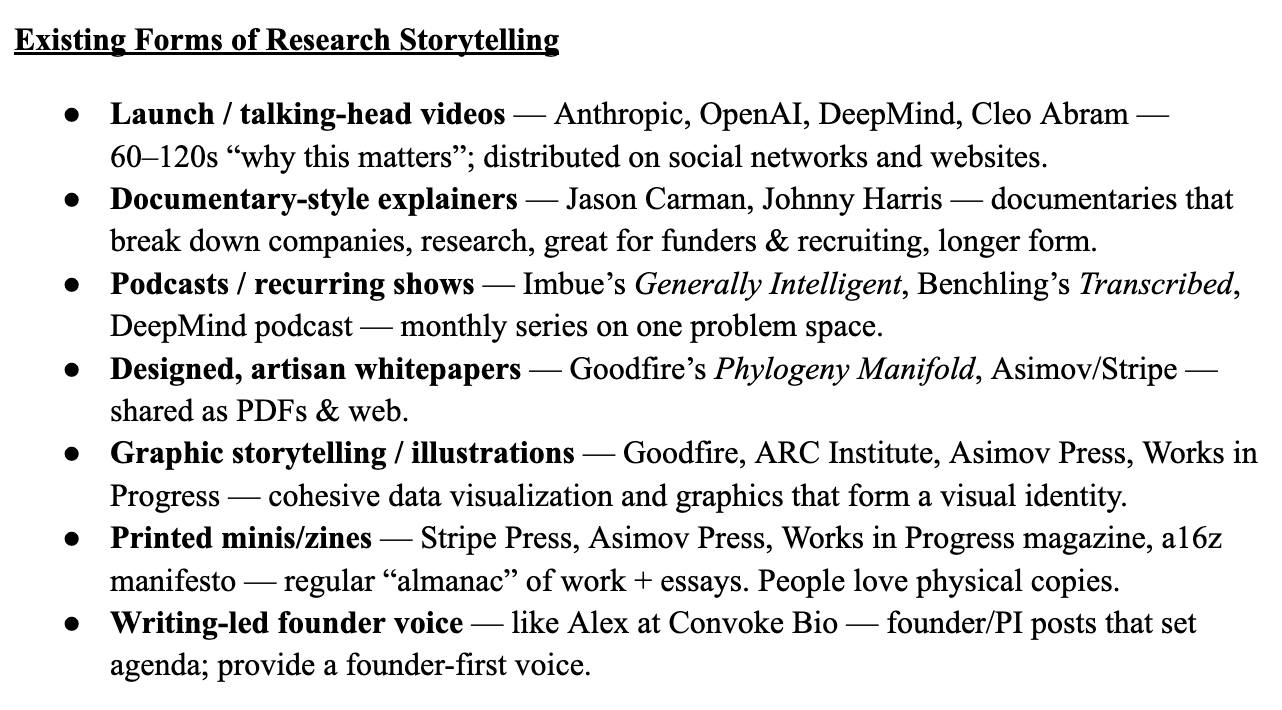
Other ways that storytelling, branding, and marketing currently exist in R&D. I’m a big fan of most of these outputs and the teams behind them.
- Tooling (the biggest bottleneck), and
- Culture (which I’ll talk about later)
When I asked researchers why they hadn’t done more with content they’d already filmed — clips of experiments, vlogs, snippets of progress, even paper logs — the answer was simple:
- It’s too high-lift, too time consuming;
- There’s no obvious payoff. Why make a video or write a post if it won’t land you funding, press, or collaborators?
Ironically, the rare times people have done this, it often has led to funding or attention (see: Jordan Harrod, Nick Desnoyer, Sofia Sanchez — all examples just within my circle alone). But the outcomes aren’t always clear or predictable, which makes most researchers default back to silence.
This is a tooling problem, not a talent problem.
Let’s pattern match from tech.
In the 1980s and 90s, only insiders could really participate in the tech scene — you had to know the right people to be “in the know.” The dot-com bubble widened the circle, but what really democratized it were the tooling and networks - importantly, both focused on distribution.
Phase 1 was the era of PCs and operating systems like MS-DOS that made computing personal. These lowered the barrier to entry dramatically. Someone in a garage (Jobs, Bezos, Gates) could hack something that reached millions and seriously challenged incumbent corporations, and it made their work culturally legible.
Phase 2 was when platforms like Blogger, Wordpress, early Hacker News (HN), and Reddit gave small teams audience discovery. Founders could tell their stories without gatekeepers - Stripe famously got early traction by circulating on HN. Around this time, GitHub made collaboration social, visible, even gamified, and code became cultural capital (startups got legitimacy for building in public, open-source contributions and projects became tokens for credibility). Some social platforms (like early Twitter) became places where founders/tinkerers could become micro-celebrities in their own niches.
Phase 3 was the new age of design and storytelling. Tools like Adobe, Figma, Canva, Substack, and Notion made creation beautiful, collaborative, and resonant by default. Design became literate, publishing frictionless, and founders themselves become part of the product. Importantly, aesthetics became synonymous with credibility.
The Notion story is one that resonated with me beyond its competitors because of the story about the founders being in isolation in Japan to shape their ethos. This is the kind of narrative that sticks. But you have to put it out there.
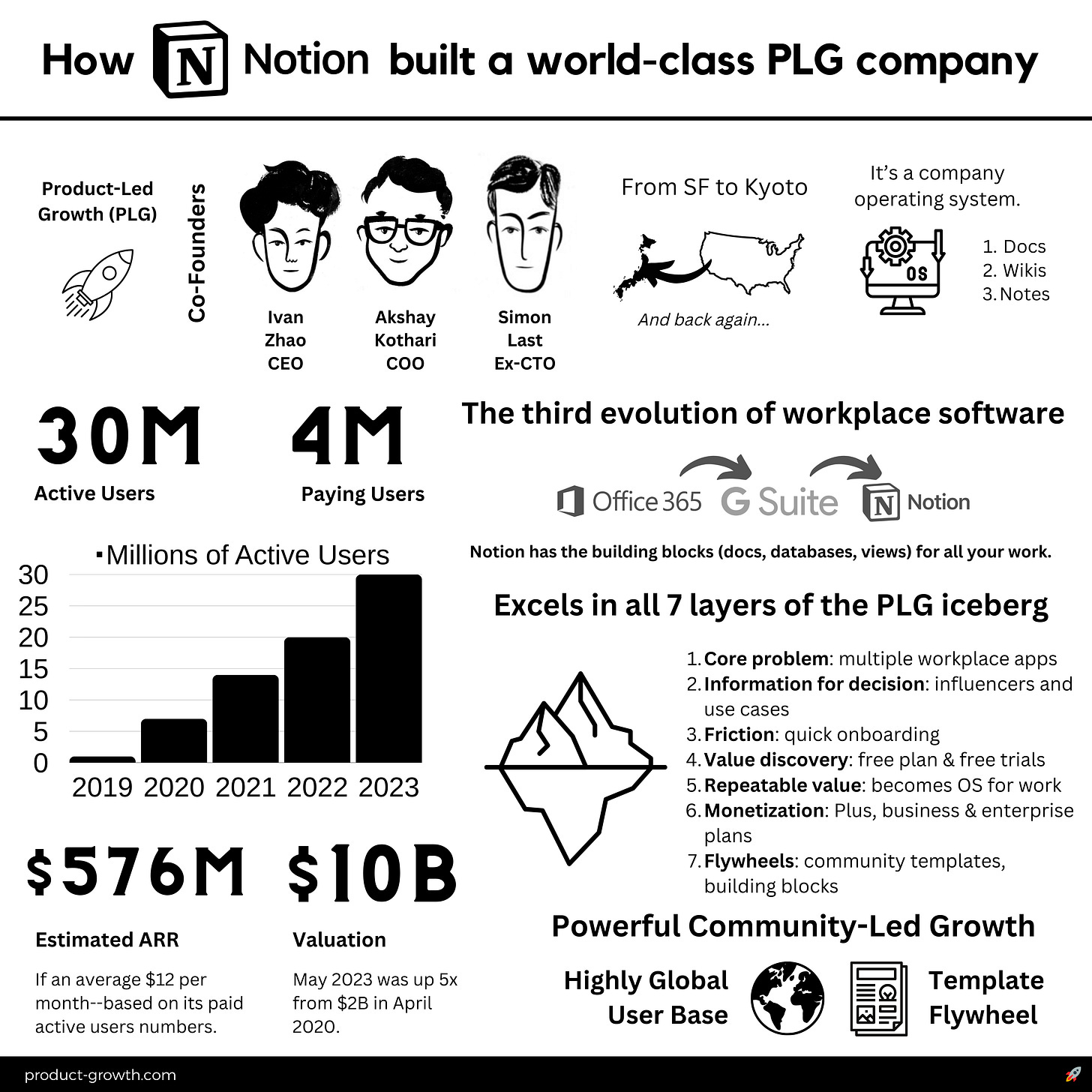
The takeaway of all this is that each step “forward” in tech has been created by some tool that increases distribution and visibility. Research is poised for the same shift.
Tooling for Distribution in Research - Wave 1
This is how it starts.
Caveat. I’ve designed this first wave to focus on two things:
- Making projects visible beyond academia (‘warming’ up the field);
- Building the 2-way street of researchers engaging with the public, and the public engaging with research, getting them familiar with each other.
There are both tooling and social network type ideas here. None of these are radical, in my opinion. They’re focused on low-lift, embedded, and distribution-first ideas. Once these exist, culture and more experimental tools will follow.
These are rough ideas sketched from a handful of conversations, and are distilled for succinctness here. I’d love your feedback and dive deeper into details — reach me at joliegcy@gmail.com or DM me on X.
- Research Multimedia Layer (publisher agnostic)
Problem → PDFs are static and hostile to newcomers; readers don’t immediately see the weight of the result. Many non-academics (including funders) bounce for a variety of reasons.
Solution (what it is) → A small set of embeddable components any publisher can host (or any reader can overlay) that turn a paper into an experience that any journal/repo can host. Quick examples include a short video abstract, explorable figures, in-article Q&As.
Similar to → YouTube cards, observable notebooks, Semantic Scholar.
Why it matters → Turns papers into experiences; gives non-specialists a real onramp and could create measurable engagement signals without becoming “social media.”
- Generatable Research Assets
Problem → Researchers are “too busy to market”; translating papers for multiple audiences/use cases is high-lift.
Solution → Upload a paper/slides → auto-produce a funder one-pager, policy brief, X/LinkedIn thread, 60-sec script + thumbnail, podcast outline (human in the loop to edit), among others.
Similar to — Canva, Runway, Adobe Suite tools, Notion AI. I could see this being built by Benchling/Adobe/Anthropic comms.
Why it matters — Makes narrative outputs as automatic as figures; standardized baseline quality and cadence even in time crunches.
- Lab Demo Platform
Problem → Reading ≠ understanding; outsiders can’t touch the result or see tangibility.
Solution → Hosted mini-apps for simulations, datasets, and model explorers with a “Try it” button + basic telemetry (plays, completes, inquiries).
Similar to → Hugging Face Spaces
Why it matters → Interactivity builds credibility, press hooks, and adoption; lowers replication friction
- Interactive PDFs + In-Paper Chats
Problem → Most paper reading is now done with the support of (or fully by) LLMs, but to ask questions, readers have to context-switch — download the PDF, copy-paste into ChatGPT, lose context, drop off.
Solution → Embed an AI chatbot directly inside the PDF/article view (or via overlay). Readers can ask: “Why does Fig. 3 flip at n > 200?” or “Summarize for policy staff” without leaving the page.
Similar to → ReadCube/Semantic Scholar overlays but with an LLM baked in.
Why it matters → Keeps attention on-page; supports experts and generalists where they are; raises comprehension and time-on-paper.
- Spotlight Videos + Episodic Series
Problem → Lab sites are static CV dumps lacking a human story. They are poorly maintained, and often not linked or obviously accessible where most people see research (Google Scholar, journals)
Solution → simple 45-sec researcher spotlights + 3-part playlists per problem space (ex. why it matters → what exists → what we’re doing differently). These can be housed at the top of a researcher’s Google Scholar pages to show where they’ve worked, what they’ve done, why it matters, on lab websites, etc.
Similar to → Netflix mini-docs, MasterClass formats.
Why it matters → Humanizes the work; hooks talent, collaborators, funders with clear arcs.
- AI Media Lab Assistant (Visibility Inside the Workflow)
Problem → Comms is ad-hoc; moments of organic ‘creative genius’ ideas slip by.Solution → Slack/Notion/workspace plugin that detects milestones and nudges prompts like: “this looks like it could be a demo/60-sec abstract/investor note,” then drafts the artifact and routes approvals.Similar to → CopilotWhy it matters → Normalizes storytelling as part of research workflow cadence, utilizing writing that’s already done for grants, papers, etc.; not an afterthought. No more procrastination.
- My Spin of HackerNews: LabNews — Curated Feed (Network)
Problem → No trusted media lane (HN-style) for release notes, demos, replications in research. Since 2023, research twitter is noisy (many academics have left), Bluesky is sanitized.
Solution → Boutique, invite-only stream (start with ~500 users) for concise release notes, interactive demos, and/or fundable “asks.” One-click submit auto-generates a TL;DR, a figure thread, and an ask; peers endorse + footnote (short, quota-limited). Weekly digest goes to funders/journalists. Structured discussion tabs. Auto cross-posting to social networks (like X, Linkedin).
Similar to → Hacker News, Product Hunt, Reddit, Trata
Why it matters → Builds a reputable distribution channel; conditions media and capital to look here first.
- Narrative Analytics
Problem → Researchers can’t see ROI outside of Google Scholar, citations, sometimes downloads; comms feels like busywork.
Solution → Dashboard of reads, watch-time, figure interactions, citations, journalist/business pickups, funder clicks, inquiry conversions gives more analytics to draw conclusions from. (answers questions like “who is the main demographic engaging with this?”)
Similar to → Mixpanel, Adobe Analytics
Why it matters → Ties storytelling to grants, partnerships, and hiring; makes the habit stick.
Why these work (and don’t spook academics)
- Low lift, in-place. Many of these can be integrated into Overleaf, arXiv, Jupyter, Benchling, Notion, Slack. These are familiar.
- Tiny, shippable artifacts.
- Clear outcomes. Dashboards tie views → citations → intros → dollars. If it isn’t seen, it isn’t funded; if it isn’t funded, it isn’t done.
On Culture
Earlier I mentioned a culture counterargument, which argues that this marketing and content arc is diametrically opposed to what — and who — researchers and research culture are “supposed” to be.
Tooling creates culture. When GitHub normalized open-source collaboration, when Figma and Canva made design fluid and shareable, when Substack made writing distribution effortless — the culture shifted alongside the tools. Once exposure widened, more people put money in, and the cycle reinforced itself. Tech learned by doing that going wide was the most efficient way to reach the people who mattered (as opposed to sending thousands of cold emails).
I’ll also outsource some of this argument to Ruxandra Teslo — my adaptation of her piece is that we’ve pre-filtered what “traits” are attractive in a public-facing researcher, and most researchers do not meet those traits. Maybe they’re awkward or nerdy, and we try to hide those parts away. But what Twitter/Reddit/niches on HN have proved to us is that the internet rewards specificity and individuality over generalizable appeal.
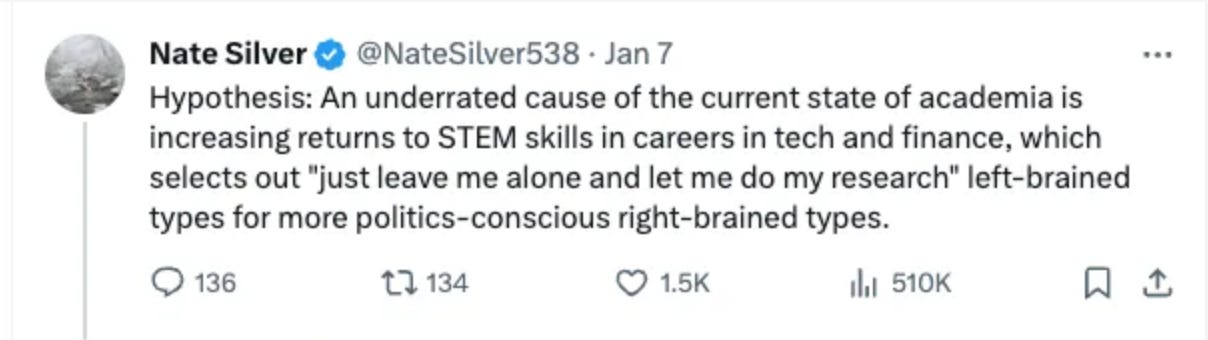
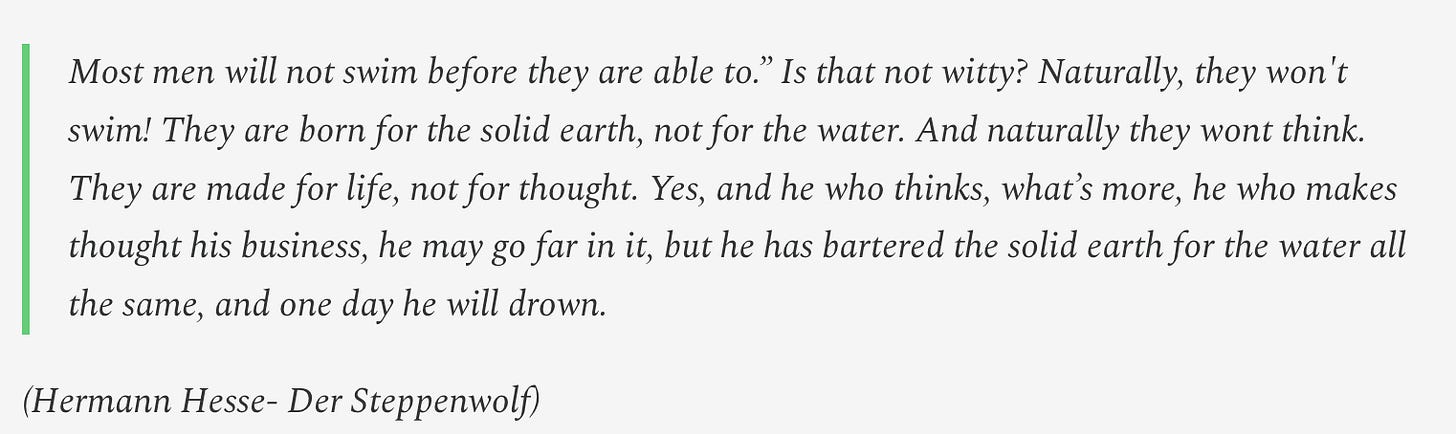
When someone is distinct and explains their work clearly, people lean in.
On status anxiety. Many academics worry comms looks low-prestige or invites peer judgment. To that, I say status accrues to those who own the surface area: Stripe made payments cool; Figma made design communal; Benchling made lab software sleek among biotechs. “Boring” categories won by narrative, not just features.
Erik Torenberg's advice can be extrapolated to researchers, who are afraid of looking "dumb" or "cringe" and losing the feeling of high status once they choose to be more creative or artistic with their stories and brand.
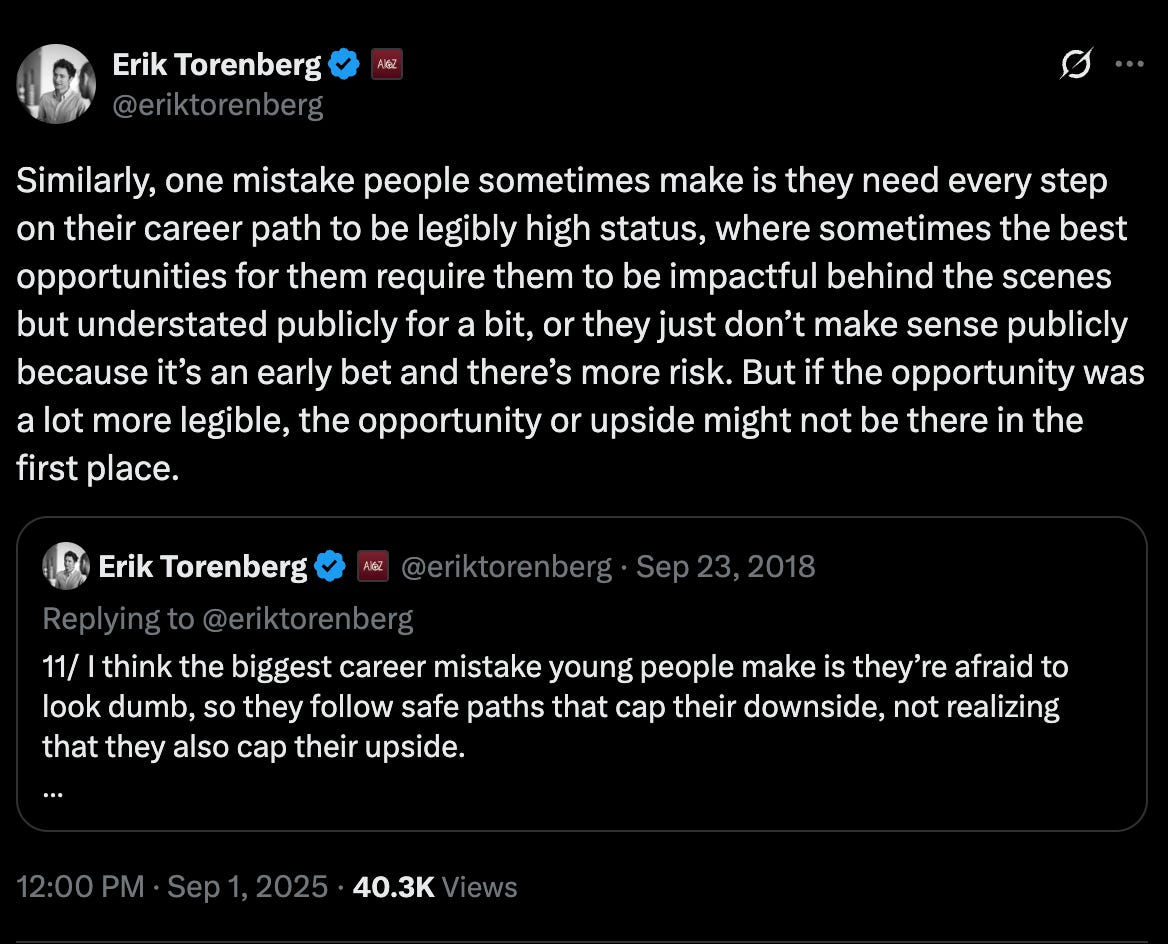
Incentives felt opaque. If comms don't obviously translate to dollars or collaborators, it gets deprioritized. That’s why this first wave of tools bake in funder-ready artifacts + analytics (briefs, demos, dashboards) so effort leads to more visible outcomes.
Okay, why think about this now and not later?
I sense this is only going to get more mainstream in the next 5-10 years, and it’s best not to play catch-up again (as research tends to do). A shift is coming from aspirational displacement: when researchers in a hostile academic environment sense “there’s no room for me here,” they build elsewhere. We’ve seen versions of this in Singapore’s talent playbook and in consumer psychology (Kyla Scanlon’s illustration of this with Labubu is great).
I suspect there will be a few more shocks to the research ecosystem — funding scares, governance fights, geopolitics — the smart move is to lay the rails before that migration.
Culture moves slowly, and then all at once. People will always resist change until you actually do something, then they jump on with the curve. Early adopters are rare, regardless of what industry you’re in, and researchers are generally especially conservative. Your tooling can’t mature until you start and get your lead users.
This is where it starts. This is the time where research stops lagging and tells a cohesive story on purpose.
If these ideas get built and used, I’ll expand a Part 3 — there are many more thoughts and ideas I have on this space.
If you’re building any of this, or want to , or if anything strikes the right chord, you know how to find me — email or X.
Subscribe
With thoughts and feedback from Nick Desnoyer, Krish Khubchand, Christina Agapakis, Erin Smith, and Hardeep Gambhir.
This means being able to translate your work into what your audience (be it funders, potential hires, boards, etc.) already care about. This doesn’t just apply topically, but visually and stylistically as well. Lulu Cheng Meservey calls these cultural erogenous zones. Stroke the right ones.