How to Prioritize Your Intellectual Life - by Andrew Harker
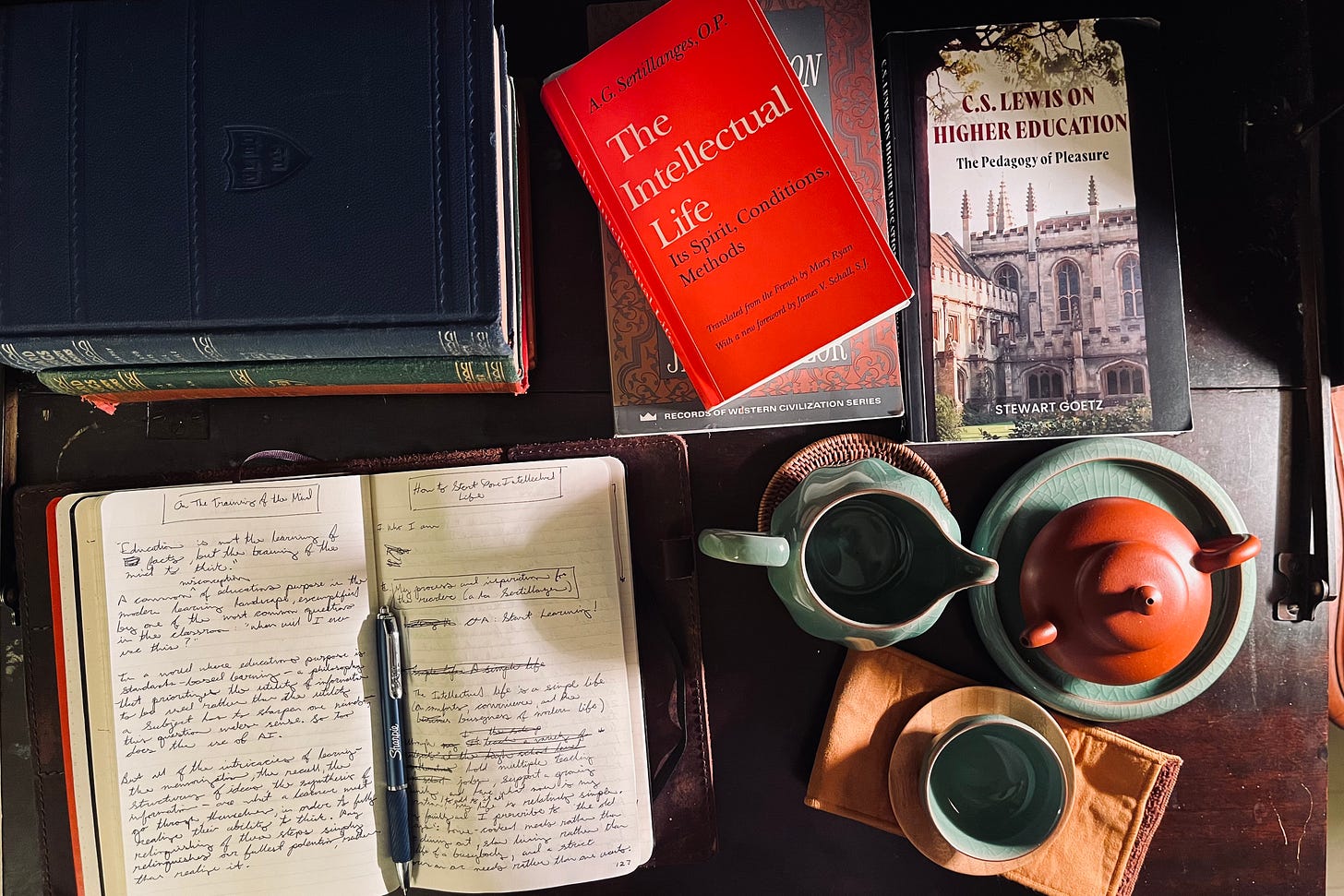
I want to begin by saying thank you. Thanks to all of you who will read this whole article, who have read all of my others thus far, and who have contributed, in any way, to this little corner of the great conversation. In such a short amount of time, not only have our numbers grown to surpass 500 subscribers, but my work even made it to the rising charts in philosophy for a short time. The experience has been humbling for someone like me: a husband, father, and high school teacher from a small town in the unassuming state of West Virginia. In many ways, I consider myself to be the commonest of men, so to all of you who have made these current achievements happen, I offer my deepest thanks. To anyone new here, welcome! This is just the beginning.
At the outset of this endeavor, I had agreed upon a singular—albeit broad—goal: to dedicate my intellectual life to re-establish and support the intellectual lives of others—a life that is for everyone and intended to help us fully realize ourselves, yet threatened in many ways by the modern world. This is my vocation, and in the words of A.G. Sertillanges, a vocation is anything but a job:
A vocation is something that cannot be had for the asking. It comes from heaven and from our first nature. The whole point is to be docile to God and to oneself as soon as they have spoken.
You are consecrated by your vocation. Will what truth wills; consent for the sake of truth to bestir yourself, to take up your abode within its proper realm, to organize your life, and, realizing your inexperience, to learn from the experience of others.
At it’s simplest, I hope that I can use my platform as a place where others are inspired to pursue a life of communal learning by reading, writing, speaking, and thinking more than they ever have. At it’s most complex, I hope that I can use it as a way to discuss the intricacies and challenges that our minds face today, which is a time defined by livelihoods of total work and minds pulled and degraded in every which way due to the influences of our environment.
But for this article, it only seems fitting that I take the time to answer what, for many, are some of the first questions:
How can I begin to prioritize my intellectual life?
What should I do if I wish to read, write, or create more?
How can I traverse the challenges that impede my intellectual goals and journey?
These are broad questions (most of which I’m sure will have their own dedicated articles in the future), but questions that, if merely touched on for now, can serve a dual purpose: to give you a great starting point for your own journey, and to give you insight into who I am. After all, I’ve never really given much of an introduction to myself, despite there being so many of you who have shown an interest in what I have to say.
So, if you’re someone who wants to know my thoughts on how you can begin to prioritize your intellectual life, or want to get to know me—the mind behind The Classical Mind—a little better, this one’s for you.
The Classical Mind is a reader-supported publication. To receive new posts and support my work, consider becoming a free or paid subscriber.
Subscribe
The Intellectual Life is a Simple Life
Although I hold multiple jobs, support a growing family, and have what now is my vocation to attend to, my life is relatively simple. My family and I subscribe to ‘the old ways’: home-cooked meals rather than dining out, slow living rather than a life of a busybody, and a strict focus on our needs rather than our wants, mostly out of necessity but always for our best interest.
The only real luxuries I have in life are my books and my tea—two things I could never have enough of. But the interesting thing is this: the simpler I made my life (i.e. the less conveniences I sought and the less preoccupied I became with ‘doing things’) the more time I was granted to do the things I cared for most. For me, those things are having quality time with my family, participating in great conversations with friends, reading more books, and drinking more tea—all necessary fuels for my intellectual life.
This is where I offer my first piece of advice. It may be an easy concept to grasp, but it is in direct opposition to the world of total work, convenience, and comfort that we live in today. Find ways to simplify your life.
One of the most ironic realities of the modern world is that, despite having access to tools to make our lives more efficient and thus allowing time for other pursuits, we fill our available time with ‘filler’ activities rather than activities that grant us fulfillment. This isn’t always our fault, but for many of us who feel as if we don’t have much time to give, a simple swipe on the home screen of our phones may prove otherwise.
A.G. Sertillanges famously advocated for two hours a day of dedicated time for someone to adequately pursue their intellectual vocation (which is the amount of time I afford myself). But even Dr. Charles Eliot—the mind behind the Harvard Classics book collection—advocated for something much more obtainable for the average person by claiming that 15 minutes a day of reading could equate to a liberal arts degree if done over the course of a year. If your daily screen time is at a minimum of 15 minutes, you can simplify your life enough to allow the time and space for reading, writing, and thinking. All you need to do is slow down, set priorities, say no to anything outside of those priorities, and devote that minimum amount of time to a certain portion of the day.
For me, I oftentimes have to limit my time to those periods of the day when the remainder of the world is quiet: the mornings and night. But that solitude, quietness, and slowness makes what little time I do have all the sweeter.
The Intellectual Life is One of Solitude
This quietness—and solitude—is something I hold near and dear and safeguard in one particular way: by creating a space that is separate from the rest of the environments I’m subjected to that are all but quiet and solitary. I’m fortunate enough to have a private study (despite it lacking a door) where I have a small secretary desk, a lamp, shelving for my books, drawers for my tea, and a couple of chairs for long sitting and deep thinking and conversations.
To me this space is paradise, which leads me to my next bit of advice: once you simplify your life enough to have time for your intellectual pursuits, make a space devoted to that time and make it a place of solitude—not solitude in the sense of loneliness, but in the sense of separateness from the loud, busy nature indicative of the rest of your day. It should be a place for you to slow down rather than speed up, a place of quiet rather than noise (although I will always make an exception for classical music), and a place that acts as a reminder of how wonderful and purposeful the time spent there is.
This space doesn’t have to be achieved through lavish or grand accoutrements, but simply through whatever means you have available to you. Some of the humblest of spaces can be the best of spaces, and has come in many shapes and sizes for me in the past: a simple corner space in a living room, a workbench in my workshop (making furniture has always been a passion of mine), and a dining table when no other desk space was available.
Regardless of resources, find your space and consecrate it.
The Intellectual Life is a Pleasurable Life
Simplifying your life and devoting time and space to pursue intellectual activities are both important, but another aspect to remember is something that, in many ways, cannot be taken from you: your outlook. For anyone wishing to read, write, or even think more, one must ensure that your time spent doing so is pleasurable. The peaceful solitude that I find in my study with old books (I rarely purchase new), the smell of freshly-brewed tea (my favorite is oolong), and the classical music as background noise (any will do) contributes to this pleasure, but the real enjoyment comes from the act of thinking, itself.
One of my favorite intellectuals, C.S. Lewis, is a perfect example of the true intellectual. In a book about Lewis’s views on the purpose of higher education— properly titled “C.S. Lewis on Higher Education: The Pedagogy of Pleasure”—the author, Stewart Goetz, describes Lewis as such:
The overwhelming evidence from Lewis’s writings, then, supports the view that he sought the life of higher education because he derived pleasure from higher-level learning and knowing. It was the pleasure which he received from intellectual activity in the forms of thinking, reading, and writing that was sought for its own sake, not the knowledge.
I’m asked all the time of my opinion on what books one should read, and although the classical educator in me will always have a soft spot for the classics, my answer is simple: whatever you find to be the most enjoyable so that you love your time spent learning rather than despise it.
In all fairness, some books are better than others, but if you want to read an informational text to learn something new, do it. If you wish to read a fantasy novel for the sole purpose of enjoyment, do it. If you want to pour over poetry, do it. If what you’re reading no longer speaks to you and something else calls, heed the call. The intellectual does not confine themselves to a box. The intellectual understands that learning is to be enjoyed and that, in many cases, knowledge is interconnected in many ways. I’ve gathered just as much joy from reading a text on the nature of wood expansion and contraction due to moisture content in furniture design as I have from spending an afternoon reading The Lord of The Rings, and I could say the same for my time spent contemplating the wisdom of Longfellow.
The Intellectual Life is a Humble Life
Lastly—and certainly not least—is the fact that the intellectual life should be a humble life. In many ways, the intellectual life is in direct opposition to the current world we find ourselves in. It should be a life of simple pleasures rather than complex preoccupations, a life that is separate from the world rather than fully immersed in it, and a life of wonder and enjoyment rather than anxious task completion. But most important is the role of humility. The intellectual knows how to say “I don’t know”, because he or she is well aware of how little they are of knowing much of anything.
In a way, the beginning of the intellectual life—wonder—is simply that: an inspired awe at that which is unknown, and the coming-to-terms with the reality that, despite your best efforts, more may remain unknown than known. After all, many parts of life are much more about the journey than the destination, and the intellectual life is no different.
I’m humbled to have so many of you be a part of this journey—a journey that is still quite young, much like myself (at the time of writing this, I’m 29 years old). I hope that what I’ve provided here is, in some way, beneficial to you on your own journey, and that you stick with me so that we can continue to read, write, converse, think, and learn together. That is what the intellectual life is all about, and it’s something that they world could use a little more of.
Show Your Support
Thank you for any contribution you’ve made while reading my work (likes, comments, restacks, etc.).
I do not withhold any of my writings behind a paywall, but as a creator who’s pulled in many directions—like my 9-5 (multiple teaching jobs) and being the sole provider of a growing family—every little bit helps to keep my creative spark alive.
If my work has benefited you in some way, please consider a premium subscription here:
Subscribe
Or, for something with less strings attached, consider donating me a “cup of tea” here:
Thank you for your support!
—Andrew Harker