多巴胺并非你想象的那样——它是我们潜意识的缔造者。 --- Dopamine is not what you think - it's the architect of our subsconscious
As a mother of two, there isn’t a lot of time for vices. But I do have one. On the top shelf in our pantry, I keep a jar of maple-roasted walnuts and pecans. Whenever I feel a little peckish, I steal a quiet moment and slip into the pantry for a sweet nut or two.
My 5 year old daughter barely used to register my clandestine foraging. (At that point in time, her primary experience with nuts was salted cashews and they don’t rank too high on her list of appetising morsels.)
It was a simpler time.
One day, when my daughter expressed a mild interest in eating one of “Mummy’s boring nuts,” I made a fatal mistake: I gave her one. Her eyes lit up in wonder. Who knew nuts could taste so good?
From that moment on, any time my hand even touches the pantry handle, my daughter wordlessly materialises behind me like some kind of teleporting leprechaun, her hand held out in entitled expectation. (And if I dare refuse, that little leprechaun turns irrationally angry.)
My darling daughter — the one who still often needs to be reminded to put her seatbelt on every morning — had learned a different association in seconds: when Mummy goes to the pantry, I get sweet nuts.
The miraculous thing is, she likely never even has that explicit conscious thought. Her subconscious simply registers my pantry trajectory and all of a sudden my daughter finds herself bodily compelled to intercept me at the cupboard, suddenly craving sweet nuts.
Brain plasticity
We may feel like we are in control of our thoughts and actions, but the bulk of our thinking and behaviour actually emerges, unprompted and automatically, from our subconscious mind.1 It is the proverbial black box that contains all our automatic programming. Anything that gets stored in that deep vault within our mind directly influences how we view ourselves and the world, and what we will automatically think or feel or do in future — our entire experience of life.
This means we should be very careful about what we let in.
Biology is clever and has the perfect solution to this. You might have heard of it as well: “brain plasticity.” Metaphorically speaking, it is as if we each have a magical barrier that protects the automatic programming of our mind from easy modification. It is very difficult to penetrate this barrier and add or update our subconscious with new information. A very special sequence of molecular events must take place in order to “punch through” and change the programming within. This molecular sequence is always the same, but the speed at which it can be activated varies dramatically.
Background plasticity
The slowest kind of plasticity learning occurs when our brain is in its default state. This is when we aren’t actively focused on anything — when our brain is in a low-engagement, automatic mode — and our surroundings simply wash over us. In this default state, it takes many many repetitions of a thought or action before it can penetrate our subconscious and become an automatic thought or action.
This is essentially “learning by osmosis,” the subconscious assimilation of knowledge and habits through repeated exposure to our everyday environment. Think of it like our environment chipping away at the thick and rigid protective barrier one little tap — one mindless thought, one mindless action — at a time. With enough taps (often in the order of hundreds), it can eventually strike through and automate that thought or action.
We learned our first language, the bulk of our social skills and other benign associations like “dark clouds means rain” via this type of slow plasticity. This is how my daughter is slowly (I won’t say painfully) learning that, when she hops in the car, she should immediately put her seatbelt on.
One tap at a time.
Focused plasticity
But we don’t spend all our time in a passive state. When we focus our attention on something, we become consciously armed with a tiny chisel and hammer and the true magic starts to happen. The barrier thins out a little, and it takes less repetitions to penetrate our subconscious and add new knowledge or actions. (It’s almost as if our brain is kindly rewarding our attention by giving us easier access.) As long as we have some point we are working towards (however small), or some task we are focused on, our attention is targeted, and the barrier responds.
The more focused we are, and the more of our brain and body we engage, the thinner the barrier becomes and the fewer times we need to tap. Sometimes a handful of taps is all that’s needed to punch through. This is why learning a musical instrument puts the brain into one of the most supercharged plasticity states possible.
Neuroscience nibble: All long-term plasticity begins with the same sequence: NMDA receptor activation → Ca²⁺ influx → CaMKII activation. This initial CaMKII activation is the molecular equivalent of a “tap on the barrier”: it creates early plasticity — a short-lived protein-modification-based strengthening that lasts minutes to hours. If enough of these “taps” recur — across minutes, hours or even days, and especially with sleep-driven replay — then CREB and other transcription factors engage. These trigger long-term plasticity: persistent, structural synaptic changes that remodel our subconscious circuitry. This is analogous to punching through the barrier and modifying the subconscious.
It is an elegant system that essentially deems anything consciously repeated enough worth automating in our subconscious. This automation offloads it from conscious thought, compressing what was once deliberate and effortful into fast and effortless. The more layered and sophisticated our subconscious, the more astonishingly complex the behaviours we can perform. Without thinking! This type of targeted plasticity is how we have the capacity to slowly transform into superhuman versions of ourselves.
Instant plasticity
The more we automate, the more capacity we free up for everything that matters next. But nature didn’t just evolve a learning system that allowed us to thrive into the future. It also evolved an elegant solution for surviving the present. Granted, this elegance is much more apparent when you look at the environment our brain evolved for, where sometimes you only had one shot to learn something, or… you died. (Even targeted plasticity learning still requires repetitions, which isn’t quite going to cut it when there is a constant threat of predators about to take you down.)
Under certain special circumstances, the magical barrier will open for a split-second, creating a direct portal to the subconscious and allowing instant modification. A one-shot learning window. Then the portal rapidly closes, disappearing as quickly as it emerged.
There are two things our ancestors needed to learn instantly: what to move towards and what to move away from. In other words, anything that meaningfully helped or harmed us triggered a one-shot update. These rapid “run towards” or “run away” updates are still with us, even though the modern triggers look nothing like the ones our ancestors faced.
And this is exactly the type of ancient update that happened when my daughter ate that first sweet little pecan. The very moment her eyes lit up, a portal to her subconscious was opened and “Run towards the nuts!” was wired directly in, along with anything that will help her achieve that in future (like seeing me wistfully eye the pantry and finding herself suddenly craving nuts, her body moving towards the pantry without thought).
The magic
Whether it is many little taps at a thick barrier, targeted hammers at a thinner barrier or a one-shot strike, our brain is constantly undergoing these three types of plasticity every day, continuously adding new knowledge and actions to our subconscious models. And it is all facilitated by that dynamically morphing magical barrier that guards the vault of our automatic programming.
So where does dopamine come into all this?
It turns out that the magical properties of that barrier — its ability to thin and grant easier access to the subconscious — is all driven by dopamine.
Spiky dopamine
You might have heard of a “dopamine spike” or a “hit of dopamine.” These quick, sharp pulses of dopamine are very different from the slow, steady background levels our brain maintains the rest of the time. (More on that in a moment.) These “spikes” are probably what dopamine is most famously known for, and often occur in conditions where something unexpectedly good (or better-than-expected) happens to us, like when a reward drops in our lap (or a nut in our palm).
When this happens, a sudden and rapid surge of dopamine is released into our brain, like a fountain of proverbial learning gasoline. And when enough gasoline hits the neural circuits that are currently lit up (by whatever we are thinking or doing at that moment), it instantly triggers the special molecular sequence for plasticity. When the spike is large enough, a portal within the barrier magically opens and those thoughts and actions become instantly stored in our subconscious.
“Spiky” dopamine is the reason my daughter now feels a sudden craving for nuts and a compulsion to move towards the pantry as soon as my hand grasps the handle.
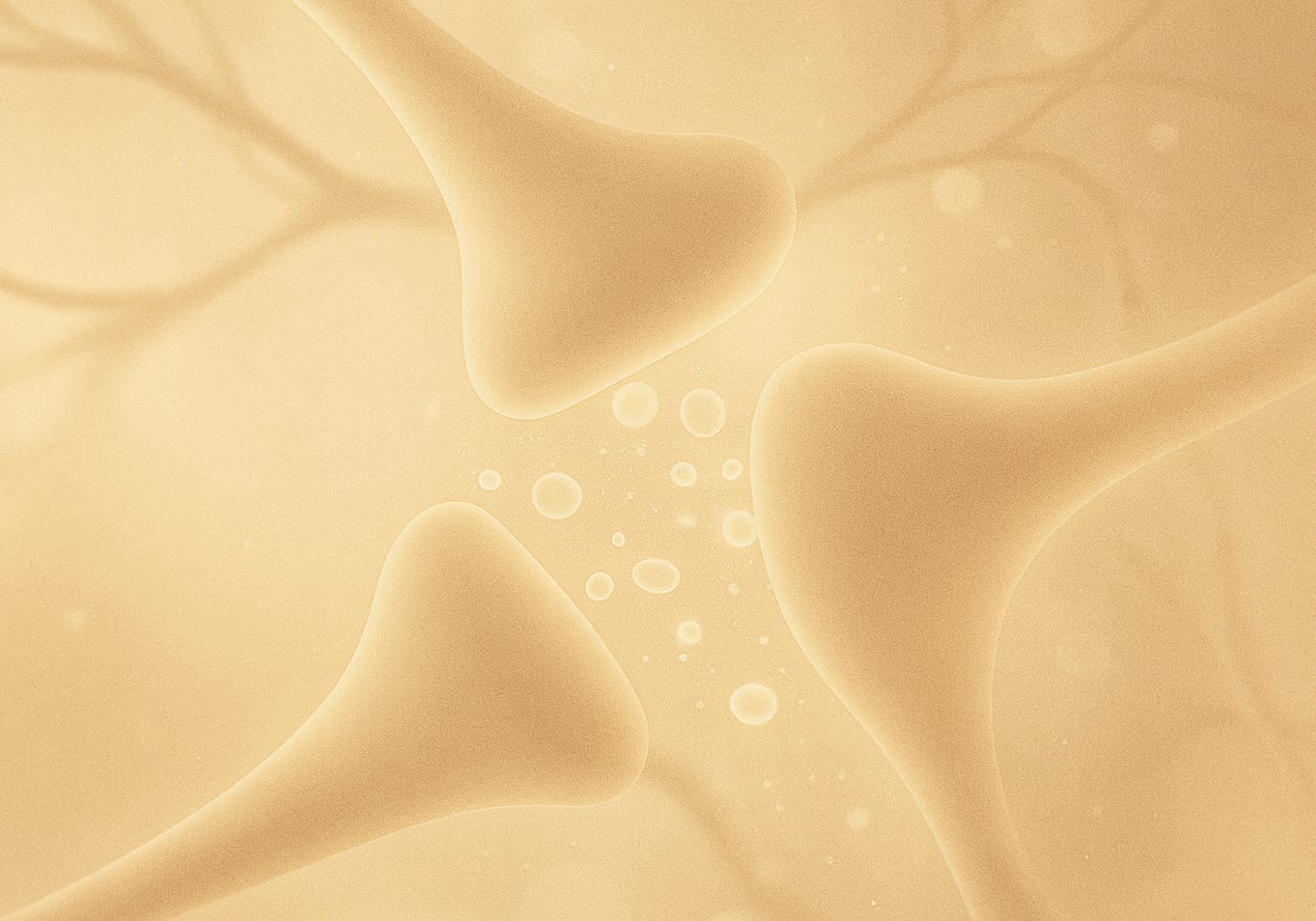
Neuroscience nibble: A large, rapid phasic spike of dopamine amplifies plasticity by tagging whichever synapses are active at that moment. Dopamine doesn’t replace the core molecular sequence (NMDA → Ca²⁺ → CaMKII); instead, through D1 receptors, it boosts cAMP signalling, which massively enhances the Ca²⁺→CaMKII part of that sequence. If the dopamine spike is large enough, this amplified signalling pushes the synapse past the threshold for CREB activation almost instantly — triggering long-term plasticity in a single moment. Not all spikes are strong enough, but the ones that are act like opening a portal into the subconscious, allowing immediate and lasting rewiring.
While this mechanism of instant plasticity is quite well known and understood, what is less well known (and seemingly far less appreciated) is the role dopamine also plays in fast and slow plasticity, in learning through repetition.
Tonic baseline
If you’ve heard of a “dopamine spike,” you might have also heard of “tonic dopamine.” This is a steady baseline of dopamine our brain maintains when we’re in that passive, attentionless state. At baseline dopamine levels, the barrier to our subconscious is thickest and most rigid. Hundreds of taps are needed to penetrate.
Elevated baseline
When we focus our attention on a task, the steady background level of dopamine begins to rise and ripple within the brain, turning it from “idling” to “engaged.” And this is where the magic happens. A raised dopamine baseline is responsible for the barrier’s wonderful and magical ability to morph and thin.
Whenever we deliberately apply our attention to something, our baseline rises and it becomes easier to add to our subconscious programming. The more focused we are and the more of our body and mind we engage, the higher it rises and the thinner the barrier becomes. Our brain rewards our effort.
Neuroscience nibble: Tonic dopamine can only directly modulate dopamine-receptor neurons, but this modulation changes the behaviour of entire microcircuits, because those dopamine-sensitive neurons regulate the activity of the broader network. So while tonic dopamine does not directly trigger the molecular sequence for long-term plasticity (unlike its spiky counterpart), it is what makes the entire sequence possible. Tonic dopamine essentially sets the global plasticity readiness of the brain by (indirectly, but vitally) regulating excitability, cAMP tone, Ca²⁺ handling, CREB thresholds and phosphorylation states.Then, when we focus deeply on something, dopamine levels rise above tonic in the parts of the brain involved in conscious thought — particularly the prefrontal cortex — and this elevated dopamine further lowers the threshold for activating the plasticity molecular sequence in whatever circuits are currently engaged. The greater the cognitive effort, the more prefrontal dopamine rises (at least within the range of normal, healthy attention), and the lower the plasticity threshold becomes. This is how the metaphorical barrier to our subconscious magically thins.
Without baseline dopamine, the barrier would be impenetrable, keeping our subconscious locked away forever. But by elevating our baseline, we can add layer upon layer of automation to our behaviour and mental models until the things we achieve seem almost indistinguishable from magic. It is just like the chess grandmasters who have chipped over 100,000 patterns into their subconscious when they say “the position speaks to me.” Or the magic of Messi and his “I see the play before it happens.”
Dopamine is not the “pleasure molecule,” or the “anticipation molecule,” or even the “habit molecule.” It is the learning molecule. Without it, plasticity is impossible.
Dopamine is magic.
If this changed the way you see your brain even a little (the way it once did for me), I’d love to have you along.
Subscribe
Thank you for reading — it truly means the world.
Before you go… try and take a moment to notice your own dopamine this week. Was there a fleeting spike — a moment of surprise or sudden clarity? And when you focused on a task, did you feel the quieter, steadier sense of forward motion — the drive of an elevated baseline? Let me know! I read every reply.
(And if you’re in the mood for something lighter, I also wrote about my daughter schooling the pants off me in a dance routine (with a little help from her supercharged dopamine system).)
Why kids learn faster than adults - and what their dopamine system has to do with it
·
December 2, 2025
One afternoon a few weeks ago, my five-year-old daughter (who is not even yet in Grade 1) came home and informed me that she needed to prepare a two-minute dance performance to a song of her choosing. And that she would have to perform this dance in front of her entire class. In eight days.
For readers who want to go deeper
Here are some of the scientific sources behind the ideas in this essay. This isn’t a full reference list, just a curated selection of core papers that have helped my understanding of dopamine, learning, and plasticity. Enjoy!
Foundational dopamine & reinforcement learning:
- Schultz W. (2016). Reward functions of dopamine. Neuron, 92(3): 646–664.
- Montague PR, Hyman SE, Cohen JD. (2004). Computational roles for dopamine in behavioural control. Nature.
- Glimcher PW. (2011). Understanding dopamine and reinforcement learning: the dopamine reward prediction error hypothesis. PNAS, 108(S3): 15647–15654.
- Watabe-Uchida M, Uchida N. (2018). Multiple dopamine pathways and their roles in reward and movement. Nat Rev Neurosci, 19: 495–508.
Phasic vs tonic dopamine:
- Grace AA. (2016). Dysregulation of the dopamine system in the pathophysiology of schizophrenia and depression. Nat Rev Neurosci.
- Niv Y, Daw ND, Dayan P. (2005). How fast to work: response vigor, motivation and tonic dopamine. Neural Computation.
- Floresco SB. (2015). The nucleus accumbens: an interface between cognition, emotion, and action. Annu Rev Psych., 66: 25–52.
Attention, PFC, and dopamine modulation:
- Goldman-Rakic PS. (1996). The prefrontal landscape: implications of functional architecture for understanding human mentation and the pathophysiology of schizophrenia. Science.
- Vijayraghavan S et al. (2007). Inverted-U dopamine D1 receptor actions on working memory. Nat Neurosci, 10: 376–384.
- Arnsten AFT. (2011). Catecholamine influences on dorsolateral prefrontal cortical networks. Biol Psychiatry.
Plasticity, eligibility traces, and molecular sequence:
- Lisman J. (2017). Glutamatergic synapses are structurally and biochemically primed for learning. Hippocampus.
- Redondo RL, Morris RGM. (2011). Making memories last: the synaptic tagging and capture hypothesis. Nat Rev Neurosci.
- Kauer JA, Malenka RC. (2007). Synaptic plasticity and addiction. Nat Rev Neurosci.
Dopamine and one-shot learning / approach-avoid:
- O’Doherty JP. (2004). Reward representations and reward-related learning in the human brain. PNAS.
- Day JJ, Carelli RM. (2007). The nucleus accumbens and Pavlovian conditioning. Nat Neurosci.
In this essay, “subconscious” is an umbrella term for the brain’s automatic systems.
Technically, different types of learning live in different places:
– habits/urges → striatum
– knowledge → cortex
– memories → hippocampus
Dopamine spikes update striatal habits instantly — cortical knowledge requires repetition and sleep. (So when I say something is “stored in the subconscious,” I’m referring to the system that automatically produces thoughts, feelings, and actions — not a single anatomical region.)