"Marc Andreessen 的语录,来自 Glasp" --- Marc Andreessen's Quotes | Glasp
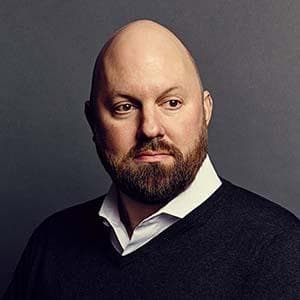
Marc Lowell Andreessen is an American entrepreneur, investor, and software engineer. He is best known as co-author of Mosaic, the first widely used Web browser; as co-founder of Netscape Communications Corporation; and as co-founder and general partner of Silicon Valley venture capital firm Andreessen Horowitz. He founded and later sold the software company Opsware to Hewlett-Packard. Andreessen is also a co-founder of Ning, a company that provides a platform for social networking websites. He sits on the board of directors of Facebook, eBay, and HP, among others. A frequent keynote speaker and guest at Silicon Valley conferences, Andreessen is one of only six inductees in the World Wide Web Hall of Fame announced at the first international conference on the World Wide Web in 1994.
"In 2000, when my partner Ben Horowitz was CEO of the first cloud computing company, Loudcloud, the cost of a customer running a basic Internet application was approximately $150,000 a month."
"An awful lot of successful technology companies ended up being in a slightly different market than they started out in. Microsoft started with programming tools, but came out with an operating system. Oracle started doing contracts for the CIA. AOL started out as an online video gaming network."
"There will be certain points of time when everything collides together and reaches critical mass around a new concept or a new thing that ends up being hugely relevant to a high percentage of people or businesses. But it’s really really hard to predict those. I don’t believe anyone can."
"I love what the Valley does. I love company building. I love startups. I love technology companies. I love new technology. I love this process of invention. Being able to participate in that as a founder and a product creator, or as an investor or a board member, I just find that hugely satisfying."
"Around ’93, ’94, the conventional wisdom about the Internet was that it was a toy for academics and researchers. So it was very, very underestimated for about two years."
"Out of ten swings at the bat, you get maybe seven strikeouts, two base hits, and if you are lucky, one home run. The base hits and the home runs pay for all the strikeouts."
"With lower start-up costs and a vastly expanded market for online services, the result is a global economy that for the first time will be fully digitally wired-the dream of every cyber-visionary of the early 1990s, finally delivered, a full generation later."
"The world is a very malleable place. If you know what you want, and you go for it with maximum energy and drive and passion, the world will often reconfigure itself around you much more quickly and easily than you would think."
"Newspapers with declining circulations can complain all they want about their readers and even say they have no taste. But you will still go out of business over time. A newspaper is not a public trust – it has a business model that either works or it doesn’t."
"Technology is like water; it wants to find its level. So if you hook up your computer to a billion other computers, it just makes sense that a tremendous share of the resources you want to use – not only text or media but processing power too – will be located remotely."
"I’m a firm believer that most people who do great things are doing them for the first time. Returning to my theory of hiring, I’d rather have someone all fired up to do something for the first time than someone who’s done it before and isn’t that excited to do it again. You rarely go wrong giving someone who is high potential the shot."
"Google is working on self-driving cars, and they seem to work. People are so bad at driving cars that computers don’t have to be that good to be much better."
"Every kid coming out of Harvard, every kid coming out of school now thinks he can be the next Mark Zuckerberg, and with these new technologies like cloud computing, he actually has a shot."
"The smartphone revolution is under-hyped, more people have access to phones than access to running water. We’ve never had anything like this before since the beginning of the planet."
"A very large percentage of economic activity is shifting online and it makes sense that there are more services that are going to charge. It also means there are going to be more people willing to pay."
"The advantage of the consumer businesses is they tend to be much broader-based, much larger number of customers, that tend to over time be a lot more predictable. The advantage of the enterprise companies is they are not as subject to consumer trend, fad, behavior."
"If you’re the village blacksmith and a model T comes along, you better become a mechanic. People’s lives are better when they get news online versus having to wait for the morning paper. It’s a lot more efficient, a lot more real time, a lot less waste."
"Qualified software engineers, managers, marketers and salespeople in Silicon Valley can rack up dozens of high-paying, high-upside job offers any time they want, while national unemployment and underemployment is sky high."
"These days, you have the option of staying home, blogging in your underwear, and not having your words mangled. I think I like the direction things are headed."
"China is very entrepreneurial but has no rule of law. Europe has rule of law but isn’t entrepreneurial. Combine rule of law, entrepreneurialism and a generally pro-business policy, and you have Apple."
"Nokia and Research in Motion needed a modern operating system. They could have bought Palm or Android before Google did, but they didn’t. Today, it’s probably too late, and at the time they would have been criticized for overpaying, but as they say – shift happens."
"There are people who are wired to be skeptics and there are people who are wired to be optimists. And I can tell you, at least from the last 20 years, if you bet on the side of the optimists, generally you’re right."
"I would say the consumer Internet companies – in a lot of ways, if you go inside the consumer Internet companies and you see how they run, it’s how all their businesses are going to run."
"Innovation doesn’t come from the big company. It never has and never will. Innovation is something new that looks crazy at first glance. It comes from the 19-year-olds and the start-ups that no one’s heard of."
"People tend to think of the web as a way to get information or perhaps as a place to carry out e-commerce. But really, the web is about accessing applications."
"If there’s been a crisis in a market, you don’t tend to have a new crisis in that market until the people who went through the last crisis aren’t in the system anymore."
"I always had the old-school model that I’m going to work for as long as I’m relevant and focus on for-profit activities and someday when I retire I’m going to learn about philanthropy."
"On the back end, software programming tools and Internet-based services make it easy to launch new global software-powered start-ups in many industries – without the need to invest in new infrastructure and train new employees."
"At a certain point in your career – I mean, part of the answer is a personal answer, which is that at a certain point in your career, it becomes more satisfying to help entrepreneurs than to be one."
"In the next 10 years, I expect at least five billion people worldwide to own smartphones, giving every individual with such a phone instant access to the full power of the Internet, every moment of every day."
"If the Net becomes the center of the universe, which is what seems to be happening, then the dizzying array of machines that will be plugged into it will virtually guarantee that the specifics of which chip and which operating system you’ve got will be irrelevant."
"My own theory is that we are in the middle of a dramatic and broad technological and economic shift in which software companies are poised to take over large swathes of the economy."
"What AI offers us is the opportunity to profoundly augment human intelligence to make all of these outcomes of intelligence – and many others, from the creation of new medicines to ways to solve climate change to technologies to reach the stars – much, much better from here."
"Every child will have an AI tutor that is infinitely patient, infinitely compassionate, infinitely knowledgeable, infinitely helpful. The AI tutor will be by each child’s side every step of their development, helping them maximize their potential with the machine version of infinite love."
"I even think AI is going to improve warfare, when it has to happen, by reducing wartime death rates dramatically. Every war is characterized by terrible decisions made under intense pressure and with sharply limited information by very limited human leaders."
"Historically, every new technology that matters, from electric lighting to automobiles to radio to the Internet, has sparked a moral panic – a social contagion that convinces people the new technology is going to destroy the world, or society, or both."
"In short, AI doesn’t want, it doesn’t have goals, it doesn’t want to kill you, because it’s not alive. And AI is a machine – is not going to come alive any more than your toaster will."
"The core mistake the automation-kills-jobs doomers keep making is called the Lump Of Labor Fallacy. This fallacy is the incorrect notion that there is a fixed amount of labor to be done in the economy at any given time, and either machines do it or people do it – and if machines do it, there will be no work for people to do."
"technology empowers people to be more productive. This causes the prices for existing goods and services to fall, and for wages to rise. This in turn causes economic growth and job growth, while motivating the creation of new jobs and new industries."
"For, as Milton Friedman observed, “Human wants and needs are endless” – we always want more than we have. A technology-infused market economy is the way we get closer to delivering everything everyone could conceivably want, but never all the way there. And that is why technology doesn’t destroy jobs and never will."
"using AI as a defensive tool. The same capabilities that make AI dangerous in the hands of bad guys with bad goals make it powerful in the hands of good guys with good goals – specifically the good guys whose job it is to prevent bad things from happening."
"To offset the risk of bad people doing bad things with AI, governments working in partnership with the private sector should vigorously engage in each area of potential risk to use AI to maximize society’s defensive capabilities."
"Chance is unintentional, it is capricious, but we needn’t conclude that chance is immune from human interventions. However, one must be careful not to read any unconsciously purposeful intent into “interventions”... [which] are to be viewed as accidental, unwilled, inadvertent, and unforseeable."
"[Chance II] involves the kind of luck [Charles] Kettering... had in mind when he said, “Keep on going and chances are you will stumble on something, perhaps when you are least expecting it. I have never heard of anyone stumbling on something sitting down.”"
"Curious people are more likely to already have in their heads the building blocks for crafting a solution for any particular problem they come across, versus the more quote-unquote intelligent, but less curious, person who is trying to get by on logic and pure intellectual effort."
"How it works: every time you access a document in Mosaic, the group annotation server [if you're using one] is queried with the URL of the document you're viewing; if any group annotations exist for that document, the group annotation server returns to Mosaic corresponding hyperlinks which are inlined into the document just like personal annotations."
"Unfortunately, our implementation at that time required a server to host all the annotations, and we didn't have the time to properly build that server, which would obviously have had to scale to enormous size. And so we dropped the entire feature."
"Permanently divorcing physical location from economic opportunity gives us a real shot at radically expanding the number of good jobs in the world while also dramatically improving quality of life for millions, or billions, of people."
"Do whatever is required to get to product/market fit. Including changing out people, rewriting your product, moving into a different market, telling customers no when you don't want to, telling customers yes when you don't want to, raising that fourth round of highly dilutive venture capital -- whatever is required."
"The caliber of a startup team can be defined as the suitability of the CEO, senior staff, engineers, and other key staff relative to the opportunity in front of them."
"On the other hand, if you ask engineers, many will say product. This is a product business, startups invent products, customers buy and use the products."
"If you ask entrepreneurs or VCs which of team, product, or market is most important, many will say team. This is the obvious answer, in part because in the beginning of a startup, you know a lot more about the team than you do the product, which hasn't been built yet, or the market, which hasn't been explored yet."
"Whenever you see a successful startup, you see one that has reached product/market fit -- and usually along the way screwed up all kinds of other things, from channel model to pipeline development strategy to marketing plan to press relations to compensation policies to the CEO sleeping with the venture capitalist."
"once a startup is successful, and you ask the founders what made it successful, they will usually cite all kinds of things that had nothing to do with it. People are terrible at understanding causation. But in almost every case, the cause was actually product/market fit."
"Smarter people have better outcomes in almost every domain of activity: academic achievement, job performance, occupational status, income, creativity, physical health, longevity, learning new skills, managing complex tasks, leadership, entrepreneurial success, conflict resolution, reading comprehension, financial decision making, understanding others’ perspectives, creative arts, parenting outcomes, and life satisfaction."
"Further, human intelligence is the lever that we have used for millennia to create the world we live in today: science, technology, math, physics, chemistry, medicine, energy, construction, transportation, communication, art, music, culture, philosophy, ethics, morality."
"In short, anything that people do with their natural intelligence today can be done much better with AI, and we will be able to take on new challenges that have been impossible to tackle without AI, from curing all diseases to achieving interstellar travel."
"The problem with the Bootleggers is that they win. The Baptists are naive ideologues, the Bootleggers are cynical operators, and so the result of reform movements like these is often that the Bootleggers get what they want – regulatory capture, insulation from competition, the formation of a cartel – and the Baptists are left wondering where their drive for social improvement went so wrong."
"It is math – code – computers, built by people, owned by people, used by people, controlled by people. The idea that it will at some point develop a mind of its own and decide that it has motivations that lead it to try to kill us is a superstitious handwave."
"First, recall that John Von Neumann responded to Robert Oppenheimer’s famous hand-wringing about his role creating nuclear weapons – which helped end World War II and prevent World War III – with, “Some people confess guilt to claim credit for the sin.”"
"And the reality, which is obvious to everyone in the Bay Area but probably not outside of it, is that “AI risk” has developed into a cult, which has suddenly emerged into the daylight of global press attention and the public conversation."
"Millenarianism is the belief by a group or movement [AI risk doomers] in a coming fundamental transformation of society [the arrival of AI], after which all things will be changed [AI utopia, dystopia, and/or end of the world]."
"Only dramatic events [AI bans, airstrikes on datacenters, nuclear strikes on unregulated AI] are seen as able to change the world [prevent AI] and the change is anticipated to be brought about, or survived, by a group of the devout and dedicated."
"In most millenarian scenarios, the disaster or battle to come [AI apocalypse, or its prevention] will be followed by a new, purified world [AI bans] in which the believers will be rewarded [or at least acknowledged to have been correct all along]."
"Second, there are certain kinds of content, like child pornography and incitements to real world violence, that are nearly universally agreed to be off limits – legal or not – by virtually every society. So any technological platform that facilitates or generates content – speech – is going to have some restrictions."
"Its opponents claim that the thought police are breathtakingly arrogant and presumptuous – and often outright criminal, at least in the US – and in fact are seeking to become a new kind of fused government-corporate-academic authoritarian speech dictatorship ripped straight from the pages of George Orwell’s 1984."
"As the proponents of both “trust and safety” and “AI alignment” are clustered into the very narrow slice of the global population that characterizes the American coastal elites – which includes many of the people who work in and write about the tech industry – many of my readers will find yourselves primed to argue that dramatic restrictions on AI output are required to avoid destroying society."
"If you don’t agree with the prevailing niche morality that is being imposed on both social media and AI via ever-intensifying speech codes, you should also realize that the fight over what AI is allowed to say/generate will be even more important – by a lot – than the fight over social media censorship."
"When technology is applied to production, we get productivity growth – an increase in output generated by a reduction in inputs. The result is lower prices for goods and services. As prices for goods and services fall, we pay less for them, meaning that we now have extra spending power with which to buy other things. This increases demand in the economy, which drives the creation of new production – including new products and new industries – which then creates new jobs for the people who were replaced by machines in prior jobs. The result is a larger economy with higher material prosperity, more industries, more products, and more jobs."
"For, as Milton Friedman observed, “Human wants and needs are endless” – we always want more than we have. A technology-infused market economy is the way we get closer to delivering everything everyone could conceivably want, but never all the way there"
"The flaw in this theory is that, as the owner of a piece of technology, it’s not in your own interest to keep it to yourself – in fact the opposite, it’s in your own interest to sell it to as many customers as possible."
"And so in reality, every new technology – even ones that start by selling to the rarefied air of high-paying big companies or wealthy consumers – rapidly proliferates until it’s in the hands of the largest possible mass market, ultimately everyone on the planet."
"In short, everyone gets the thing – as we saw in the past with not just cars but also electricity, radio, computers, the Internet, mobile phones, and search engines. The makers of such technologies are highly motivated to drive down their prices until everyone on the planet can afford them."
"It is, it’s just not being driven by technology, it’s being driven by the reverse, by the sectors of the economy that are the most resistant to new technology, that have the most government intervention to prevent the adoption of new technology like AI – specifically housing, education, and health care."
"The AI cat is obviously already out of the bag. You can learn how to build AI from thousands of free online courses, books, papers, and videos, and there are outstanding open source implementations proliferating by the day."
"second, let’s mount major efforts to use AI for good, legitimate, defensive purposes. Let’s put AI to work in cyberdefense, in biological defense, in hunting terrorists, and in everything else that we do to keep ourselves, our communities, and our nation safe."
"Big AI companies should be allowed to build AI as fast and aggressively as they can – but not allowed to achieve regulatory capture, not allowed to establish a government-protect cartel that is insulated from market competition due to incorrect claims of AI risk."
"Startup AI companies should be allowed to build AI as fast and aggressively as they can. They should neither confront government-granted protection of big companies, nor should they receive government assistance."
"Even when open source does not beat companies, its widespread availability is a boon to students all over the world who want to learn how to build and use AI to become part of the technological future, and will ensure that AI is available to everyone who can benefit from it no matter who they are or how much money they have."
"To prevent the risk of China achieving global AI dominance, we should use the full power of our private sector, our scientific establishment, and our governments in concert to drive American and Western AI to absolute global dominance, including ultimately inside China itself. We win, they lose."
"First, there is the undeniable, irrepressible phenomenon that Rap Genius already is – the definitive online community of rap aficionados; one of the fastest growing web sites in Y Combinator's history; a thriving ecosystem of ideas, artists, and fans."
"Only a handful of people know that the big missing feature from the web browser – the feature that was supposed to be in from the start but didn't make it – is the ability to annotate any page on the Internet with commentary and additional information."
"In my experience, the most frequent case of great team paired with bad product and/or terrible market is the second- or third-time entrepreneur whose first company was a huge success. People get cocky, and slip up."





Glasp is a social web highlighter that people can highlight and organize quotes and thoughts from the web, and access other like-minded people’s learning.